


Triadobatrachus
Name meaning:
Triassic frog
Period of life:
250 million years ago
Period:
Triassic period
Habitat:
Lakes and marshes
Taxonomy:
Amphibians
Countries:




 Hyperodapedon


Chaohusaurus


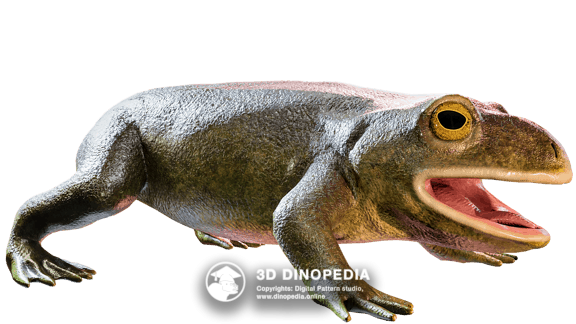
What does the name mean: “Triassic frog”.
Triadobatrachus was an extinct genus of ancient amphibians considered one of the earliest known relatives of modern frogs and toads. It lived during the Early Triassic, around 250 million years ago, on the territory of present-day Madagascar.
Triadobatrachus was a relatively small animal, reaching only about 10 cm in length. Its body was elongated and retained a short tail, unlike modern frogs, which lose their tails as adults. One of the most interesting features of Triadobatrachus was its large number of vertebrae—at least 26—whereas modern frogs possess only 4 to 9. This suggests that Triadobatrachus was less specialized for jumping than its modern relatives and probably moved using a combination of hopping and swimming.
The skull of Triadobatrachus already resembled that of modern frogs: it was broad, with large eye sockets, and consisted of a lattice of thin bones separated by large openings. Like modern amphibians, it likely absorbed oxygen both through its lungs and through its skin.
Although Triadobatrachus was discovered in deposits formed in an ancient river delta, the structure of its body and the presence of fossilized terrestrial plants nearby indicate that it probably spent at least part of its life on land. Much like many modern frogs, it may have lived near bodies of water, using them for reproduction and protection from predators while venturing onto land in search of food. It is believed that Triadobatrachus was a predator feeding on small invertebrates.
Triadobatrachus represents an important link in the evolutionary history of frogs, displaying transitional features between more primitive amphibians and modern members of the order Anura. Its study helps paleontologists better understand the origin and evolution of one of the most widespread groups of modern vertebrates.
Discussions
Start the first one!
 Start a discussion
Other animals




 INTERESTING FACTS
 PUZZLES
 HOME
HOME
 3D MODEL "SKIN"
 3D MODEL "MUSCLES"
 3D MODEL "SKELETON"
 VISION
 NEIGHBORS
 VOICE ACTING
 AR - MODE
 GALLERY
 HISTORY OF DISCOVERIES

