


Uintatherium

Name meaning:
Beast from Uinta
Period of life:
56–34 mya
Period:
Paleogene period
Habitat:
Lakes and marshes
Taxonomy:
Mammals
Countries:





 Titanoboa


Basilosaurus


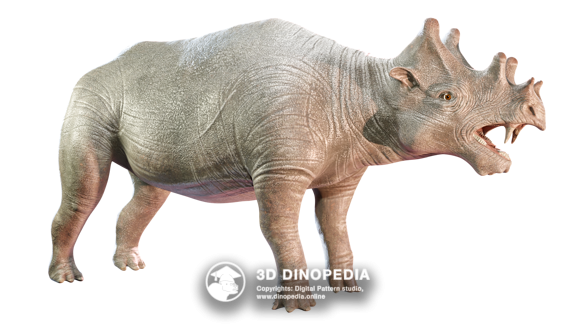
Uintatherium was one of the most striking mammals of the Eocene epoch, which followed shortly after the extinction of the dinosaurs. This massive herbivore belonged to the order Dinocerata and outwardly resembled a modern rhinoceros, although it was not closely related to rhinos. Uintatherium lived approximately 56–34 million years ago in what is now the United States and China. Its name derives from the Uinta Mountains in Wyoming, where its first fossils were discovered.
It was a large animal: up to 4 meters long and weighing around 2 metric tons. It stood on four thick, column-like legs, well adapted to supporting its heavy body. Its skin was thick and hairless, likely providing protection from insects and helping prevent overheating in a warm climate.
The most distinctive feature of Uintatherium was the three pairs of bony protuberances on its head. These skin-covered structures resembled the ossicones of a giraffe and were likely used for display or during mating contests. Males also possessed large downward-pointing canine tusks, which may have been used in combat with rivals or as a means of intimidation.
Its teeth were adapted exclusively for plant material, indicating a diet of soft leaves, grasses, and shoots. It likely inhabited warm, humid environments near ancient lakes. The structure of its skull suggests that it had a relatively small brain, implying simple, instinct-driven behavior typical of large herbivores.
Uintatherium lived in a world where ecosystems were being reshaped after the extinction of the dinosaurs. Its massive silhouette among dense subtropical forests symbolized the rapid rise and diversification of mammals in the early Cenozoic.
Discussions
Start the first one!
 Start a discussion
Other animals




 INTERESTING FACTS
 PUZZLES
 HOME
HOME
 3D MODEL "SKIN"
 3D MODEL "MUSCLES"
 3D MODEL "SKELETON"
 VISION
 NEIGHBORS
 VOICE ACTING
 AR - MODE
 GALLERY
 HISTORY OF DISCOVERIES

