


Ornimegalonyx

Name meaning:
A bird with gigantic claws
Period of life:
126 000 - 7000 years ago
Period:
Quaternary period
Habitat:
Rainforests
Taxonomy:
Birds
Countries:




 Doedicurus


Neanderthal



What does the name mean: "bird with gigantic claws".
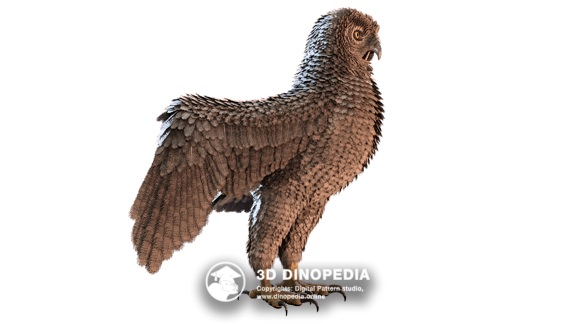
Among the many extinct animals of the Ice Age, Ornimegalonyx oteroi occupies a special place — a gigantic owl that once inhabited the territory of modern Cuba. It was one of the most mysterious and impressive creatures of the Pleistocene, challenging our usual understanding of what an owl could be.
Ornimegalonyx was a true giant among owls. According to paleontologists, its height ranged from 60 to 120 centimeters — nearly the size of a modern child. Despite belonging to the owl family, this bird was almost completely flightless. Its wings were shortened, and weak flight muscles prevented it from taking to the air.
In exchange, evolution equipped it with extraordinarily powerful legs armed with long, sharp claws. These deadly “spears” served as formidable weapons, transforming Ornimegalonyx into a swift and dangerous terrestrial predator.
Researchers believe that the giant owl was nocturnal. Its large forward-facing eyes provided excellent binocular vision, while its highly developed hearing allowed it to detect even the faintest sounds. This combination made it a superb hunter of the night.
Most likely, Ornimegalonyx concealed itself within the shadows of tropical forests, silently stalking prey such as large rodents, birds, and even small Cuban ground sloths. Its plumage was probably cryptically colored, helping it blend into the jungle background and remain invisible until the moment of attack.
Ornimegalonyx is a striking example of how isolated island environments can produce extraordinary forms of life. Having lost the ability to fly, this owl evolved into a true ground predator — the “owl-cat” of its time.
After the extinction of many of Cuba’s large animals at the end of the Pleistocene, Ornimegalonyx disappeared as well, leaving behind only fossilized bones — silent witnesses to a vanished world in which a giant owl once ruled the forests of the night.
Discussions
Start the first one!
 Start a discussion
Other animals







 INTERESTING FACTS
 PUZZLES
 HOME
HOME
 3D MODEL "SKIN"
 3D MODEL "MUSCLES"
 3D MODEL "SKELETON"
 VISION
 NEIGHBORS
 VOICE ACTING
 AR - MODE
 GALLERY
 HISTORY OF DISCOVERIES

