


Cyamodus
Name meaning:
Bean tooth
Period of life:
242–237 million years ago
Period:
Habitat:
Coasts
Taxonomy:
Reptiles
Countries:






 Tanystropheus


Mixosaurus


Origin of the Name
The name Cyamodus means “bean tooth,” derived from the Greek kyamos (“bean”) and odous (“tooth”).
Overview
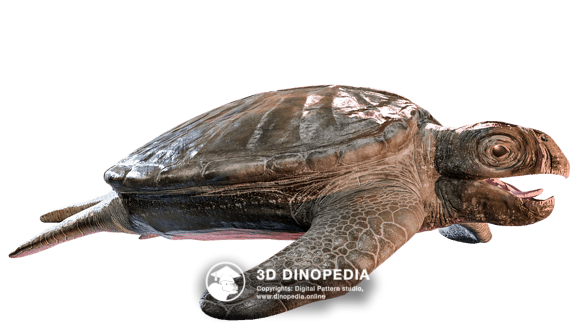
Cyamodus lived on Earth during the Middle Triassic, about 242–237 million years ago, and was an extraordinary member of the placodonts—a group of extinct marine reptiles recognized for their armored protection. The genus name Cyamodus, meaning “bean tooth,” refers to the shape of its teeth, which were adapted to crushing the shells of mollusks. Fossils of Cyamodus have been discovered in ancient marine deposits across Europe and China.
In appearance, Cyamodus looked like a cross between a turtle and a lizard. Its body was broad and flattened, measuring about 1.3–1.5 meters in length, with short, sturdy limbs. One of its most striking features was its two-part shell (or armor): a large section that covered the back from the neck to the hips, and a smaller section protecting the hips and the base of the tail. This armor consisted of numerous hexagonal or round bony plates, providing reliable protection against predators.
Cyamodus had a wide, heart-shaped head. Unlike other placodonts, it featured a short rostrum (the front part of the skull), small eye sockets, and large temporal openings. The teeth at the front of the jaws were flat and rounded, perfectly suited for crushing the hard shells of mollusks.
Though a slow swimmer, Cyamodus preferred to stay near the seabed, where it could search for food. Compared to its contemporaries, such as nothosaurs, Cyamodus was sluggish—yet among its closest relatives, it was relatively spry. Its two-part shell allowed more mobility than the single-piece armor of placodonts like Henodus. Cyamodus’s diet consisted mainly of mollusks and other bottom-dwelling invertebrates, whose shells it easily crushed with its powerful jaws.
Despite its armor, Cyamodus was not invincible. Juveniles were likely prey for large fish and marine reptiles, while adults may have fallen victim to formidable predators such as ichthyosaurs.
Studying Cyamodus and other placodonts is crucial for understanding reptile evolution and adaptations to marine environments. These animals are a remarkable example of convergent evolution, having developed turtle-like features despite not being closely related to turtles.
Discussions
 Start a discussion
Other animals




 INTERESTING FACTS
 PUZZLES
 HOME
HOME
 3D MODEL "SKIN"
 3D MODEL "MUSCLES"
 3D MODEL "SKELETON"
 VISION
 NEIGHBORS
 VOICE ACTING
 AR - MODE
 GALLERY
 HISTORY OF DISCOVERIES


