


Tyrannosaurus
Name meaning:
Tyrant lizard
Period of life:
68-66 mya
Period:
Cretaceous period
Habitat:
Mangrove forests and bayous
Taxonomy:
Theropods
Countries:






 Triceratops


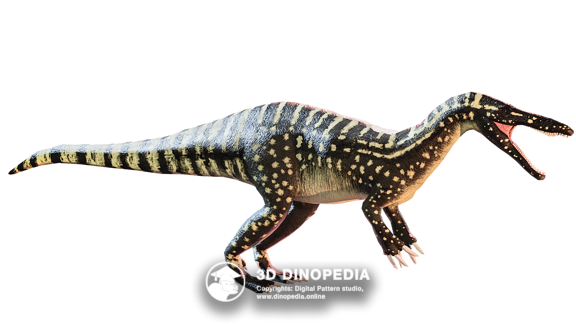
Concavenator


Tyrannosaurus is one of the most famous dinosaurs of the Late Cretaceous and a true icon of that era. This gigantic predator lived in western North America about 73–66 million years ago, during the final millions of years before the extinction of the non-avian dinosaurs. Its name — Tyrannosaurus rex — combines Greek and Latin and translates as «tyrant lizard king».
The size of Tyrannosaurus was extraordinary even by dinosaur standards: body length reached about 12.5 meters, and mass approached 9–10 metric tons. Hip height was roughly four meters. Its massive body was counterbalanced by a long, heavy tail that functioned as a dynamic stabilizer. Tyrannosaurus moved on two powerful hind limbs, while its proportionally small forelimbs, bearing two robust claws, were once considered vestigial but likely assisted in grasping prey or helping the animal rise from a resting position.
The primary weapon of this «king of lizards» was its skull and jaws. The skull could reach up to 1.5 meters in length and housed massive jaws armed with heterodont teeth — some sharp and chisel-like, others thick and banana-shaped. The largest teeth, including the root, reached up to 30 centimeters. With this dentition and bite force, Tyrannosaurus was capable of crushing bone several centimeters thick.
Scientists continue to debate whether Tyrannosaurus was primarily an active predator or relied heavily on scavenging. However, its well-developed binocular vision — likely superior to that of modern hawks — along with acute olfaction and sensitive hearing, strongly support the interpretation of an active apex predator.
Despite its enormous size, Tyrannosaurus was not necessarily slow-moving. Extensive skeletal pneumaticity reduced overall body mass, allowing relatively efficient locomotion. Nevertheless, due to biomechanical constraints and stress on the limb bones, fully grown adults were probably incapable of sustained running. The tail acted as a counterbalance to the massive head, maintaining stability during locomotion.
Estimated lifespan for this «royal lizard» is approximately 30 years — a considerable age for such a large terrestrial vertebrate.
The familiar abbreviation «T. rex» may no longer refer to a single species. In 2024, paleontologists described a new species, Tyrannosaurus mcraeensis, suggesting that «T. rex» may have been only one representative of a broader lineage — and that the «king of the dinosaurs» may once have had equally formidable relatives.
Discussions
 Start a discussion

 2
2
 1
1
 133
133
Other animals





 INTERESTING FACTS
 PUZZLES
 HOME
HOME
 3D MODEL "SKIN"
 3D MODEL "MUSCLES"
 3D MODEL "SKELETON"
 VISION
 NEIGHBORS
 VOICE ACTING
 AR - MODE
 GALLERY
 HISTORY OF DISCOVERIES

