


Edmontosaurus

Name meaning:
Lizard from Edmonton
Period of life:
73–66 mya
Period:
Cretaceous period
Habitat:
Mangrove forests and bayous
Taxonomy:
Ornithopods
Countries:





 Mosasaurus


Pachycephalosaurus


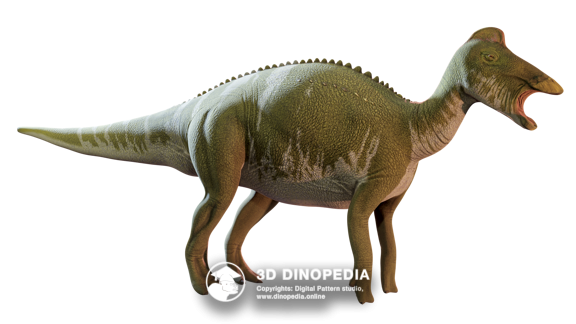
Edmontosaurus is one of the most well-known hadrosaurs that lived in North America approximately 70–66 million years ago, during the Late Cretaceous. It received its name in honor of the Canadian city of Edmonton, in the vicinity of which its remains were first discovered. These herbivorous giants roamed ancient plains where today the Canadian prairies and the American Great Plains extend.
Edmontosaurus impressed with its size: most adult individuals reached 12 meters in length and weighed up to 7 tonnes, while some specimens, judging by discoveries of caudal vertebrae, may have grown to as much as 15 meters—making them among the largest hadrosaurids known to science.
Edmontosaurus moved primarily on four limbs, relying on powerful hind legs and shorter forelimbs. When necessary, it could rear up onto its hind limbs to reach the upper branches of trees. Its skull, more than one meter long, had a characteristic triangular shape and ended in a flat beak covered with a keratinous layer—hence its «duck-billed» appearance.
The jaws of Edmontosaurus were a true marvel of nature. They contained dental batteries composed of numerous teeth: in each functional zone, several teeth were positioned one above another simultaneously. The upper teeth gradually wore down, while new ones advanced from below—allowing the dinosaur to chew even coarse vegetation throughout its life.
The skin of Edmontosaurus was covered with dense scales resembling the skin of modern lizards and likely helped protect the body from minor injuries and bites.
These dinosaurs most likely lived on coastal plains and in lowlands, where they found an abundance of vegetation. Edmontosaurus apparently formed large herds, migrating in search of fresh pastures. Their diet consisted of leaves, needles, shoots, ferns, and cones.
However, even their impressive size did not protect Edmontosaurus from predators. On fossilized bones found in Montana, paleontologists discovered tooth marks of Tyrannosaurus—indicating that the duck-billed giants often became its prey.
Thus, Edmontosaurus, once peacefully grazing on prehistoric plains, became an important component of the ancient ecosystem—a giant that combined the strength of a herd animal with remarkable anatomical adaptations for life in the world of dinosaurs.
Discussions
 Start a discussion
Other animals





 INTERESTING FACTS
 PUZZLES
 HOME
HOME
 3D MODEL "SKIN"
 3D MODEL "MUSCLES"
 3D MODEL "SKELETON"
 VISION
 NEIGHBORS
 VOICE ACTING
 AR - MODE
 GALLERY
 HISTORY OF DISCOVERIES

