


Hyperodapedon

Name meaning:
Over the surface
Period of life:
237–227 million years ago
Period:
Triassic period
Habitat:
Deserts and semi-deserts
Taxonomy:
Archosaurs
Countries:






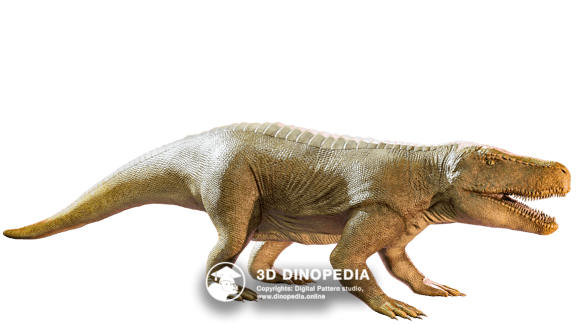 Saurosuchus


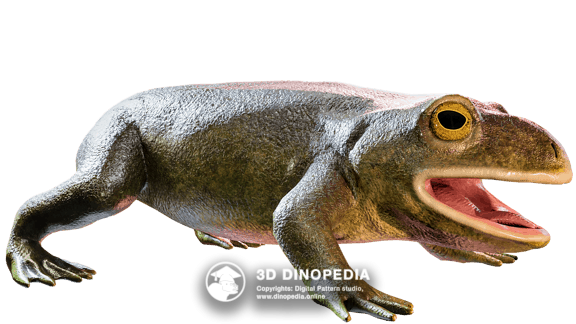
Triadobatrachus


What does the name mean: The name Hyperodapedon has Greek origins. It is derived from hupér — “above” or “over,” and dápedon — “floor,” “pavement,” or “surface.” Thus, the name can be translated as “above the pavement” or “over the surface”.
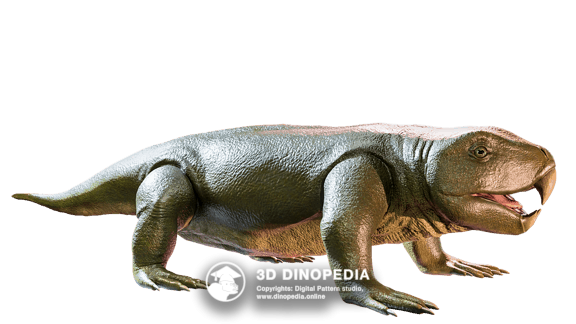
Hyperodapedon was one of the most distinctive and best-studied rhynchosaurs, living during the Late Triassic approximately 237–227 million years ago. Like other rhynchosaurs, it belonged to the archosauromorphs — an ancient group of reptiles distantly related to the archosaurs, from which crocodilians and dinosaurs later evolved.
In appearance, these animals were highly unusual: the body resembled that of a pig, the beak resembled that of a bird, and some aspects of their behavior may have been similar to rodents. Rhynchosaurs, including Hyperodapedon, were among the most widespread herbivores of their time. Thanks to the large number of fossil discoveries on different continents, they are relatively well studied, although some species originally assigned to Hyperodapedon were later separated into distinct genera.
Hyperodapedon was a stocky, powerfully built animal with thick limbs, a broad torso, and a massive skull. Its body length was about 1.3 meters, while the skull usually measured 13–18 centimeters. The largest known species, Hyperodapedon huxleyi, had a skull approximately 42 centimeters long. In addition to its beak, it possessed a highly specialized dental system: several rows of teeth were present on each side of the upper jaw, while the lower jaw carried a single row. This arrangement created a powerful shearing mechanism for processing food. The upper jaw teeth were positioned on specialized tooth plates formed by fused bones, and a longitudinal groove between the rows accommodated the teeth of the lower jaw.
The skull of Hyperodapedon had large eye sockets containing sclerotic rings — bony structures that supported the eyes. Its olfactory capsules were also large, indicating a well-developed sense of smell.
Hyperodapedon moved on four powerful limbs. The hind legs were especially strong and bore large claws. Its feet were broad, while the claws were tall and narrow, resembling adaptations seen in modern digging animals. However, in Hyperodapedon, these traits were more pronounced in the hind limbs than in the forelimbs.
It is generally believed that Hyperodapedon was herbivorous and fed primarily on seed ferns. Its jaws allowed it to efficiently bite and process tough vegetation. The beak-like premaxillary bones and powerful hind limbs may also have been used for digging up food. The genus likely disappeared at the end of the Triassic along with the decline of the plants that formed its primary food source.
During the Late Triassic, Hyperodapedon was widely distributed. Its fossils are found in many regions, particularly where phytosaurs were absent. Remains have been discovered in Argentina, Brazil, Canada, India, Tanzania, Scotland, and the United States. Such a broad distribution is explained by the existence of the supercontinent Pangaea during the Triassic. Hyperodapedon inhabited much of this landmass, and after Pangaea broke apart, its fossils became scattered across several modern continents.
Discussions
Start the first one!
 Start a discussion
Other animals






 INTERESTING FACTS
 PUZZLES
 HOME
HOME
 3D MODEL "SKIN"
 3D MODEL "MUSCLES"
 3D MODEL "SKELETON"
 VISION
 NEIGHBORS
 VOICE ACTING
 AR - MODE
 GALLERY
 HISTORY OF DISCOVERIES

