


Placodus

Name meaning:
Plate tooth
Period of life:
240 million years ago
Period:
Triassic period
Habitat:
Coasts
Taxonomy:
Marine reptiles
Countries:






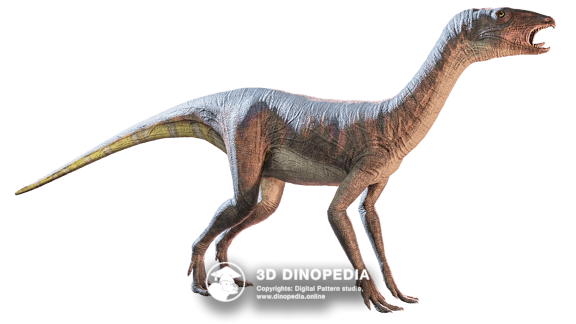 Silesaurus


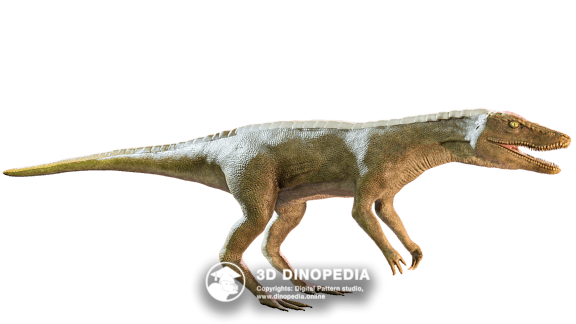
Hesperosuchus


What does the name mean: from Greek plax (plakos) — “plate” and odous — “tooth,” meaning “plate tooth”,
Placodus was a remarkable marine reptile of the Middle Triassic, living about 240 million years ago. Its fossils have been found in Central Europe (Germany, France, Poland) and China. The name refers to its distinctive flattened crushing teeth.
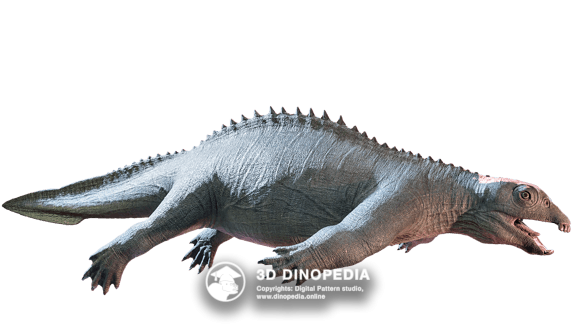
Placodus had a very distinctive appearance. It was a relatively large reptile, reaching 2–3 meters in length, with a heavy body and a long tail. Its vertebrae, ribs, and abdominal ribs (gastralia) were strongly thickened, and a row of bony knobs ran along the spine. Together, these features formed a protective “armor” and increased body weight, helping the animal remain stable on the seafloor of shallow seas.
Its limbs were short and robust, resembling those of a lizard with webbing between the digits rather than true flippers. In water, it maneuvered using these limbs and its flattened tail, but it was not a fast swimmer—rather, a slow-moving bottom-dweller.
The head of Placodus was relatively small and highly specialized. At the front of the jaws were chisel-shaped teeth used to scrape mollusks and other benthic organisms from the substrate. Deeper in the mouth were broad, flat crushing teeth that functioned like stones, breaking hard shells to access soft tissue. Like many early reptiles, it possessed a parietal opening for a pineal (“third”) eye—a light-sensitive organ likely involved in regulating circadian rhythms.
Although Placodus may have occasionally ventured onto land, it spent most of its life in shallow coastal waters, moving slowly along the seabed. There it searched for shellfish, brachiopods, other invertebrates, and possibly algae.
Placodus belongs to the placodonts, a specialized group of Triassic marine reptiles. This group included both relatively lightly armored forms like Placodus and heavily armored species resembling turtles. The study of Placodus and its relatives provides important insight into how early reptiles adapted to marine environments and evolved diverse defensive and feeding strategies.
Discussions
Start the first one!
 Start a discussion
Other animals





 INTERESTING FACTS
 PUZZLES
 HOME
HOME
 3D MODEL "SKIN"
 3D MODEL "MUSCLES"
 3D MODEL "SKELETON"
 VISION
 NEIGHBORS
 VOICE ACTING
 AR - MODE
 GALLERY
 HISTORY OF DISCOVERIES

