


Megatherium

Name meaning:
Giant beast
Period of life:
5–0.01 mya
Period:
Quaternary period
Habitat:
Savannas and plains
Taxonomy:
Mammals
Countries:






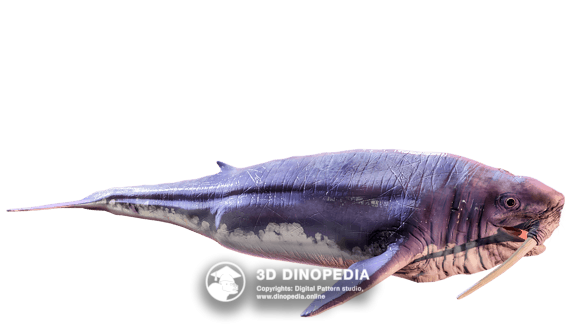 Odobenocetops


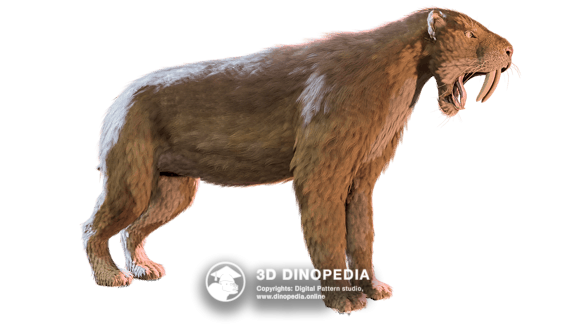
Smilodon


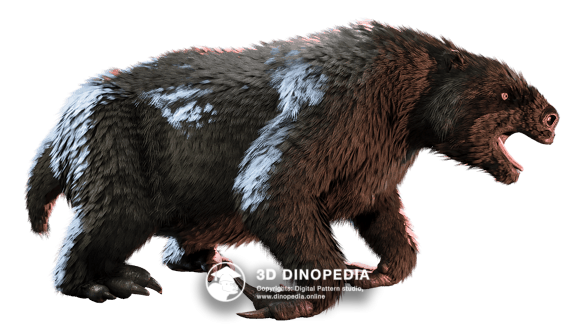
Megatherium was a giant ground sloth and one of the most impressive inhabitants of the Ice Age. It lived from about 2 million to 10,000 years ago across much of South America and parts of North America. The first remains were discovered in 1787 in Argentina, and the find caused a sensation. In the 19th century, when a mounted skeleton of this colossal animal was first displayed in European museums, visitors were astonished by its immense size.
Megatherium was truly gigantic. Standing upright on its hind legs, it could reach 6 meters in height and weigh around 4 tons—comparable to a modern rhinoceros. Its thick tail acted as a support, helping it balance vertically while pulling down high branches. Powerful forelimbs equipped with 17-centimeter claws and strong musculature allowed it not only to break branches with ease but also to defend itself against predators.
The body of this «shaggy giant» was covered with dense fur, which helped it withstand cooler periods of the Ice Age climate. It spent most of its time on the ground, moving slowly in search of food. Its diet consisted mainly of grass, leaves, roots, and fruits, though it may occasionally have consumed carrion. Some hypotheses suggest that Megatherium was an opportunistic omnivore.
At first, these animals lived only in South America—on the territories of present-day Brazil, Argentina, Uruguay, and Chile. Around 3 million years ago, however, the Isthmus of Panama formed, connecting the two continents. Megatherium then migrated into North America as part of the Great American Biotic Interchange.
One hypothesis proposes that some Megatherium individuals may have lived along coastlines, feeding on aquatic vegetation, and that their massive bones helped maintain neutral buoyancy, facilitating movement in water.
Megatherium became extinct relatively recently—around 10,000 years ago—likely due to climate change and human hunting pressure. Yet memories of it may have survived in the legends of Indigenous peoples of South America, who told stories of «earth monsters» inhabiting valleys and caves.
Today, standing before the enormous skeleton of Megatherium in a museum, it is easy to imagine these gentle giants roaming prehistoric plains—massive, peaceful, and majestic, like shadows of a vanished world.
Discussions
 Start a discussion

 0
0
 2
2
 335
335
Other animals








 INTERESTING FACTS
 PUZZLES
 HOME
HOME
 3D MODEL "SKIN"
 3D MODEL "MUSCLES"
 3D MODEL "SKELETON"
 VISION
 NEIGHBORS
 VOICE ACTING
 AR - MODE
 GALLERY
 HISTORY OF DISCOVERIES

