


Hesperosuchus

Name meaning:
Western crocodile
Period of life:
237–227 million years ago
Period:
Triassic period
Habitat:
Floodplains
Taxonomy:
Archosaurs
Countries:




 Placodus


Saurosuchus
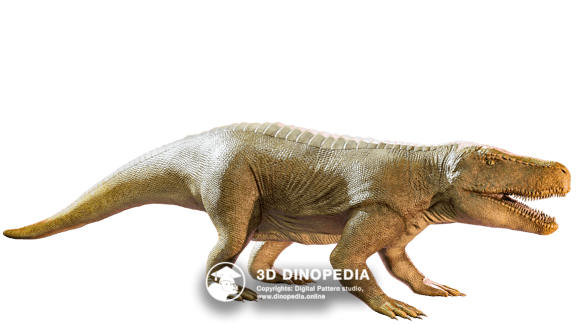


What does the name mean: “Western crocodile”.
Hesperosuchus agilis is an extinct genus of crocodylomorph that lived about 230 million years ago. Its name comes from Greek: hesperos (“western”) and suchus (“crocodile”), referring to the location of its discovery in the western part of North America.
Fossils of Hesperosuchus have been found in Upper Triassic (Carnian) deposits of Arizona and New Mexico. When paleontologists first examined its skull and light, gracile skeleton, they thought it might be an ancestor of large predatory dinosaurs. Only later did it become clear that it belonged not to the dinosaur lineage, but to the crocodile branch of archosaurs—making it one of the early crocodylomorphs.
In size, Hesperosuchus was comparable to a large dog, reaching about 1.2–1.5 meters in length. It had a slender, lightweight body and a long tail used for balance. Its hind limbs were longer and stronger than the forelimbs, and they were held beneath the body rather than sprawled to the sides as in modern crocodiles. It likely moved on all fours but could run quickly and with agility, like a small terrestrial sprinter. Its light skeleton reduced weight, while the tail helped maintain balance during rapid movement.
The skull of Hesperosuchus was relatively large for its body, with a narrow snout and sharp, serrated teeth—well suited for a predatory lifestyle. It likely hunted small vertebrates such as lizards, juvenile reptiles, and possibly small amphibians.
Although fully terrestrial, Hesperosuchus probably lived close to water. In the Late Triassic, the region of present-day northern Arizona was dominated by rivers, lakes, and floodplains rich in life. Large herbivores and diverse fauna provided abundant prey. Hesperosuchus likely ran along firm ground near water margins, functioning as a fast land predator—associated with aquatic environments, but not a water hunter like its modern crocodilian relatives.
Discussions
Start the first one!
 Start a discussion
Other animals






 INTERESTING FACTS
 PUZZLES
 HOME
HOME
 3D MODEL "SKIN"
 3D MODEL "MUSCLES"
 3D MODEL "SKELETON"
 VISION
 NEIGHBORS
 VOICE ACTING
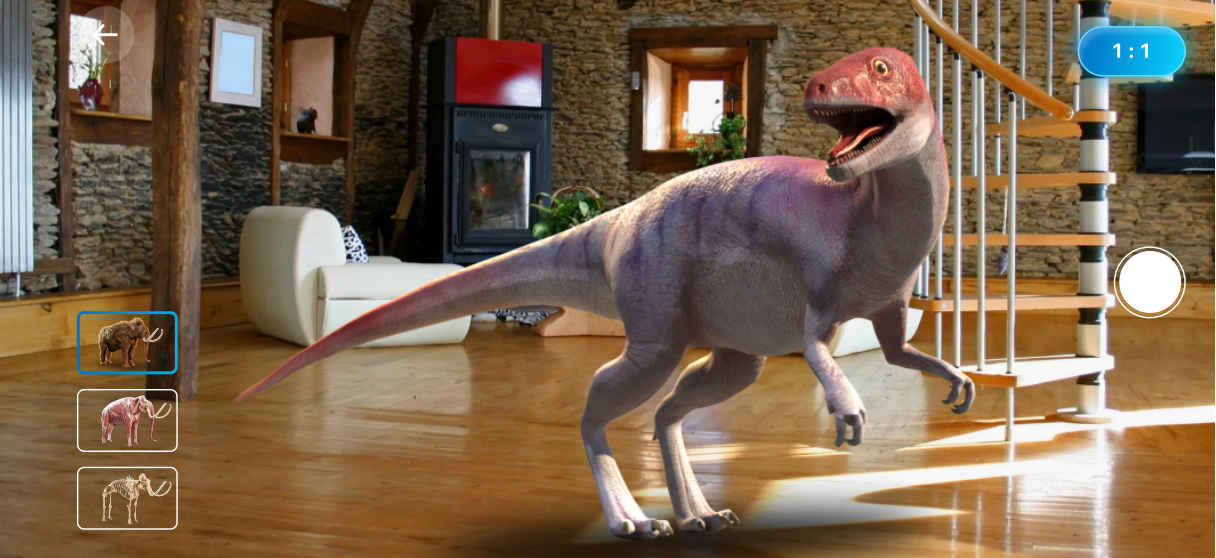
 AR - MODE
 GALLERY
 HISTORY OF DISCOVERIES

