


Armadillosuchus

Name meaning:
Armadillo crocodile
Period of life:
72–68 million years ago
Period:
Cretaceous period
Habitat:
Floodplains
Taxonomy:
Crocodilians
Countries:




 Nipponosaurus


Bajadasaurus


What does the name mean: “armadillo crocodile”
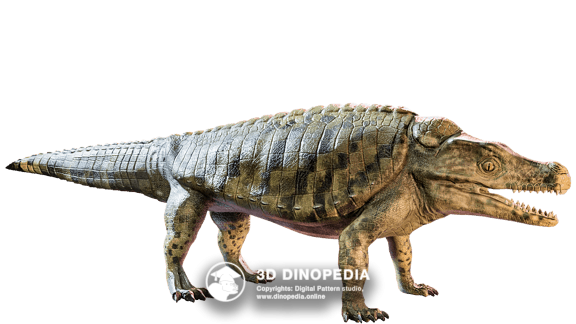
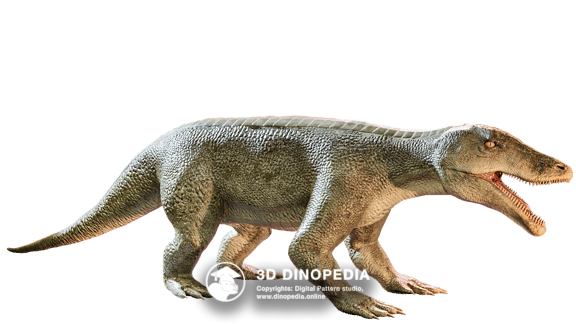
Armadillosuchus was a remarkable creature that lived in what is now Brazil about 70 million years ago, during the Late Cretaceous period. It was an extinct genus of crocodylomorph belonging to the family Sphagesauridae. Despite its relationship to crocodiles, Armadillosuchus possessed a number of unusual features that made it unlike any other representative of this group.
The most striking feature was the unusual armor covering its body. It consisted of hexagonal bony plates — osteoderms — connected by flexible skin-like tissues. This structure provided Armadillosuchus with reliable protection from predators, although it did not allow the animal to curl into a ball like modern armadillos. It was precisely this armor that gave the animal its name, since it resembled the shell of an armadillo, while “suchus” comes from the Greek word for “crocodile.”
Armadillosuchus was not a particularly large animal, reaching about 2 meters in length and weighing around 120 kilograms. A significant portion of this weight was undoubtedly formed by the armor itself. Unlike most crocodiles, Armadillosuchus had long legs and sharp claws on its feet. Its jaws contained fang-like teeth, giving it the appearance of a predator.
However, despite its formidable appearance, Armadillosuchus probably preferred peaceful coexistence with other species. Scientists believe it was an omnivorous animal that fed mainly on plant material. It may have used its powerful jaws and fang-like teeth to crush hard roots and tough plant stems.
It is also possible that it fed on small invertebrates such as mollusks, worms, and insects, and it may not have avoided scavenging carrion.
There is a hypothesis that Armadillosuchus led a burrowing lifestyle similar to that of modern armadillos. Its strong claws and powerful forelimbs could well have been used for digging burrows, which served as shelters from predators and harsh environmental conditions.
Armadillosuchus is an important subject for studying the evolution of crocodylomorphs. It demonstrates the remarkable diversity of this group of animals, their ability to adapt to a wide range of environments, and their capacity to occupy very different ecological niches.
Discussions
Start the first one!
 Start a discussion
Other animals



 INTERESTING FACTS
 PUZZLES
 HOME
HOME
 3D MODEL "SKIN"
 3D MODEL "MUSCLES"
 3D MODEL "SKELETON"
 VISION
 NEIGHBORS
 VOICE ACTING
 AR - MODE
 GALLERY
 HISTORY OF DISCOVERIES

