


Guiyu

Name meaning:
Ghost fish
Period of life:
425 million years ago
Period:
Silurian period
Habitat:
Marine environment
Taxonomy:
Bony fish
Countries:




 Tujiaaspis


Eryops


What the name means: “ghost fish”
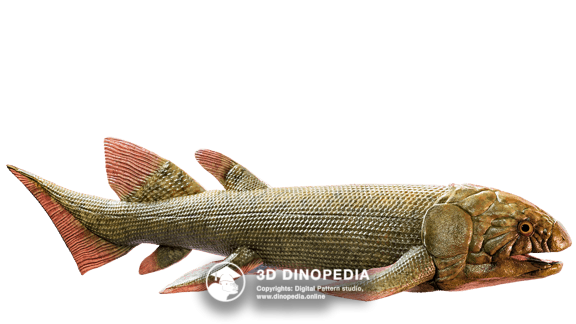
Guiyu oneiros — is one of the oldest known bony vertebrates. Moreover, it may represent the earliest member of the lobe-finned fishes (Sarcopterygii), the very lineage that, hundreds of millions of years later, gave rise to amphibians and ultimately all terrestrial vertebrates, including humans.
The remains of Guiyu were discovered in Yunnan Province in southern China, in marine deposits dating to approximately 425 million years ago. This places it in the Late Silurian, a time when life was only beginning to take its first steps onto land. Marine ecosystems of that era were already highly diverse: armored fishes, ancient arthropods, and the first coral reefs formed a dynamic world in which Guiyu occupied its place as part of a major evolutionary transition.
This fish was about 30 cm long, with a streamlined body, shiny scales, and well-developed fins. In general shape it resembled modern perch-like fishes, yet it combined features of both primitive armored fishes (placoderms) and modern bony fishes. Its pelvic girdle included not only internal skeletal elements, as in modern fishes, but also external dermal plates — a relic of ancient armor. Its fins bore large spines, likely serving as protection against predators.
The skull of Guiyu was covered with bony plates, and its body was protected by scales coated with ganoine, a shiny enamel-like tissue still seen today in sturgeons and gars. Behind the head were three large bony plates — remnants of a pectoral armor reminiscent of placoderms. These characteristics make Guiyu a true evolutionary mosaic, combining traits from several major vertebrate lineages.
The study of Guiyu helps scientists understand the transition from heavily armored fishes to more flexible, faster-moving bony fishes — the ancestors of all modern fish. These findings illuminate one of the most important stages in vertebrate evolution: the emergence of bony skeletons, which later became a defining feature of an enormous diversity of life.
Guiyu is not merely an ancient fish — it is evidence of early evolutionary experimentation, a first step toward the complex organisms that would eventually include us.
Discussions
Start the first one!
 Start a discussion
Other animals




 INTERESTING FACTS
 PUZZLES
 HOME
HOME
 3D MODEL "SKIN"
 3D MODEL "MUSCLES"
 3D MODEL "SKELETON"
 VISION
 NEIGHBORS
 VOICE ACTING
 AR - MODE
 GALLERY
 HISTORY OF DISCOVERIES

