


Dunkleosteus

Name meaning:
Named in honor of David Dunkle
Period of life:
382-358 mya
Period:
Devonian period
Habitat:
Marine environment
Taxonomy:
Placodermes
Countries:






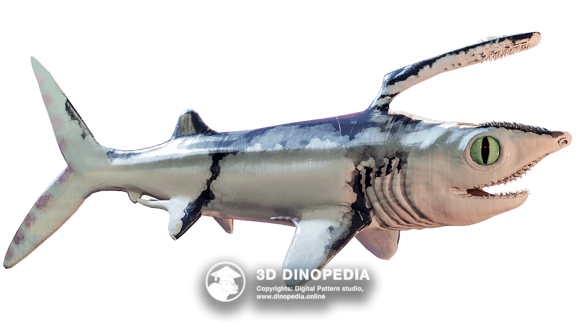 Falcatus


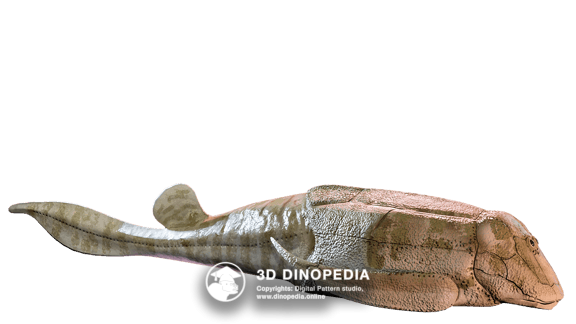
Cephalaspis
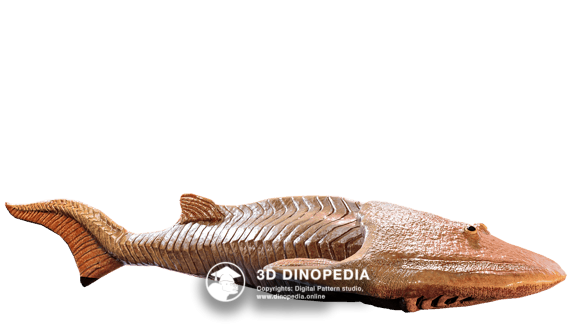


Named in honour of the palaeontologist David Dunkle.
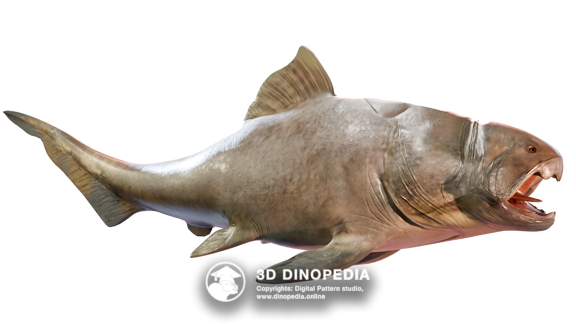
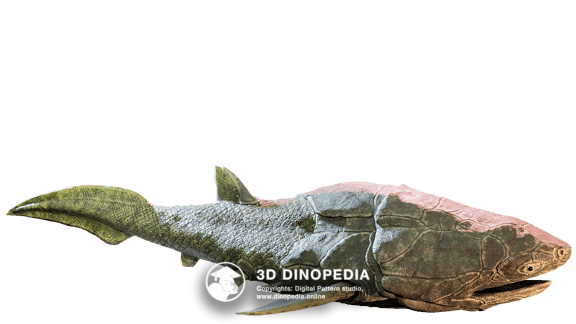
Dunkleosteus was an ancient armoured fish and one of the most formidable predators of the seas of the Late Devonian. It lived around 360 million years ago in the waters that covered parts of what is now North Africa, Europe, and America. These seas were shallow, rich in life, and ideally suited for hunting.
Dunkleosteus lived in the near-surface layers of the water, close to the shores, but according to scientists, it may also have ventured into the open sea. Its body reached a length of more than 4 metres, although its exact size remains a matter of debate. In appearance, it resembled a shark encased in heavy bony armour — cumbersome, yet incredibly powerful.
Two front fins helped this ancient predator control its movement, while its tail fin probably had triangular lobes, allowing it to make rapid bursts. In addition to the tail, it also had small anal and dorsal fins, which helped maintain stability in the water.
Dunkleosteus holds a special place in evolution: scientists believe it was one of the first vertebrates capable of actively grasping and crushing its prey before swallowing it. Its jaws did not have teeth in the usual sense — instead, there were sharp bony plates that functioned like powerful scissors. With a single swift movement, they could cut through the armour of another fish or shatter its bones.
Like all fish, Dunkleosteus breathed using gills. It was the apex of the food chain of its time — the seas were ruled by this ancient armored giant, whose strength and power had no equal.
Discussions
 Start a discussion

 0
0
 1
1
 333
333
Other animals























 INTERESTING FACTS
 PUZZLES
 HOME
HOME
 3D MODEL "SKIN"
 3D MODEL "MUSCLES"
 3D MODEL "SKELETON"
 VISION
 NEIGHBORS
 VOICE ACTING
 AR - MODE
 GALLERY
 HISTORY OF DISCOVERIES

