


Deinosuchus
Name meaning:
Terrible crocodile
Period of life:
82-73 mya
Period:
Cretaceous period
Habitat:
Freshwater environment
Taxonomy:
Crocodilians
Countries:




 Therizinosaurus


Nemegtbaatar


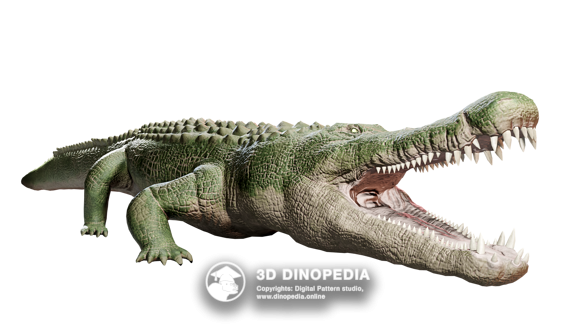
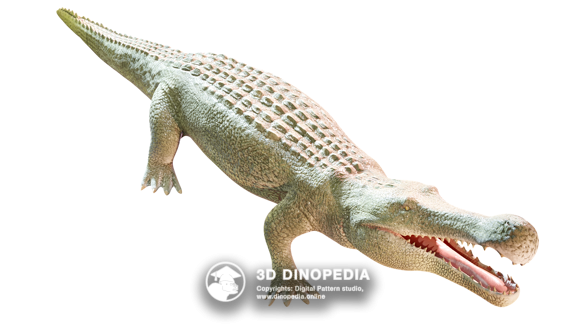
Deinosuchus was one of the most formidable predators of the Late Cretaceous. This giant belonged to a lineage of ancient crocodilians within the alligatoroid group and lived approximately 80 million years ago. Its first remains—two enormous teeth—were discovered as early as 1858 in North Carolina, in the eastern United States. Several years later, paleontologists also found osteoderms, the bony plates that armored the predator’s back. It later became clear that Deinosuchus was an ancient relative of modern alligators and caimans, but far larger and more powerful than any living representative.
The name Deinosuchus literally translates as «terrible crocodile», and it was well deserved. Its length reached up to 12 meters, and its mass may have exceeded 8 metric tons. Its jaws contained more than forty robust teeth capable of crushing even the shells of marine turtles. Estimates of its bite force reach about 102,000 newtons, with alternative calculations suggesting values as high as 356,000 newtons. For comparison, the bite force of a modern crocodile is around 34,000 newtons, several times lower. Deinosuchus likely possessed the most powerful bite in the history of life on Earth.
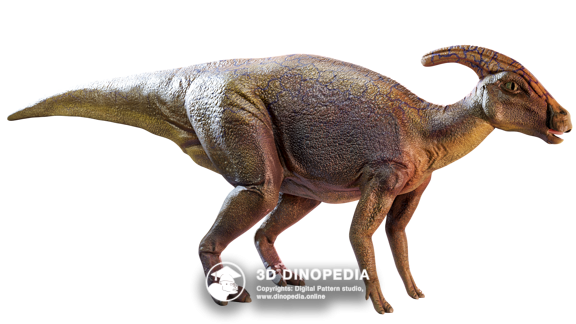
With such destructive strength, it posed a serious threat to dinosaurs. Large Deinosuchus individuals inhabiting western North America are thought to have ambushed prey near bodies of water, where dinosaurs such as Cosmoceratops or Parasaurolophus came to drink. As soon as a victim approached, the crocodilian lunged forward, driving its teeth into the prey. Its grip was lethal: the predator dragged the dinosaur into the water and began rotating its body—a behavior known as the «death roll»—tearing the carcass apart.
In the eastern part of the continent, Deinosuchus individuals were smaller. They preyed on turtles, large fish, and smaller dinosaurs, but even these smaller forms remained dangerous predators.
Studies indicate that Deinosuchus individuals lived for a very long time—more than 50 years. During the first 35 years, they grew slowly, gradually developing into giants. Over the course of its life, a single Deinosuchus may have witnessed the rise and fall of multiple generations of dinosaurs—animals with which it shared its ancient world.
Discussions
 Start a discussion

 0
0
 1
1
 99
99
Other animals




 INTERESTING FACTS
 PUZZLES
 HOME
HOME
 3D MODEL "SKIN"
 3D MODEL "MUSCLES"
 3D MODEL "SKELETON"
 VISION
 NEIGHBORS
 VOICE ACTING
 AR - MODE
 GALLERY
 HISTORY OF DISCOVERIES

