


Giant moa

Name meaning:
Terrifying giant bird
Period of life:
2,5 million years ago - 1445 years CE
Period:
Quaternary period
Habitat:
Savannas and plains
Taxonomy:
Birds
Countries:



 Hydrodamalis gigas


Haikouichthys


What does the name mean: The name moa comes from a Polynesian word meaning “fowl” or “domestic bird,” which was later applied to these birds. In 1843, Richard Owen gave them the general name “moa,” sometimes interpreted as “terrifying giant bird.”
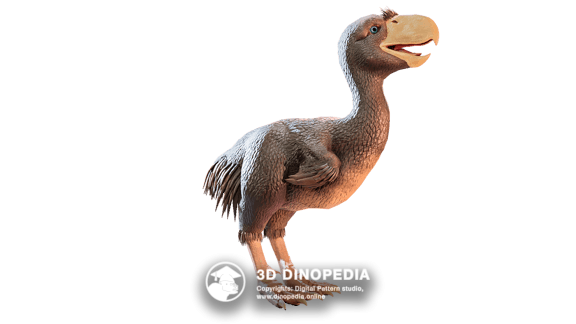
Moa were not a single species or genus, but a collective term for several families of extinct flightless birds from New Zealand. In popular culture, moa are often associated with gigantic forms; however, very large size characterized only part of the group, especially members of the genus Dinornis — the so-called “giant moa.”
The giant moa (Dinornis) was a genus of extinct ratite birds that included two large species: Dinornis robustus from the South Island and Dinornis novaezealandiae from the North Island. These birds inhabited a variety of environments, including forests, shrublands, coastal dunes, and subalpine zones.
In terms of size, Dinornis ranked among the largest birds known: D. robustus could reach about 3.6 m in height with its neck extended, while D. novaezealandiae reached about 3 m; the largest females are estimated to have weighed around 240–250 kg.
Like other ratites, Dinornis possessed a sternum without a keel — the bony ridge required for attachment of flight muscles. Their wings were completely absent. They were characterized by a long neck, a relatively small flattened head, a strong slightly curved beak, and powerful elongated hind limbs. Despite their great size, Dinornis had relatively slender rather than massive proportions.
Dinornis species were herbivorous and occupied the ecological niche of large terrestrial plant-eaters. Their diet included leaves, twigs, shoots, flowers, fruits, and seeds of various plants. It is suggested that the North Island species consumed tougher vegetation, whereas the South Island species had a more varied diet depending on local environmental conditions.
The extinction of Dinornis occurred relatively recently — during the 15th century, shortly after Polynesian settlement of New Zealand. The main causes are considered to be intensive hunting and habitat transformation, including widespread burning of vegetation.
The study of Dinornis is important for understanding the evolution of ratite birds, the functioning of island ecosystems, and the consequences of human impact on isolated faunas.
Discussions
Start the first one!
 Start a discussion
Other animals







 INTERESTING FACTS
 PUZZLES
 HOME
HOME
 3D MODEL "SKIN"
 3D MODEL "MUSCLES"
 3D MODEL "SKELETON"
 VISION
 NEIGHBORS
 VOICE ACTING
 AR - MODE
 GALLERY
 HISTORY OF DISCOVERIES

