


Megalodon


Name meaning:
Big tooth
Period of life:
23–4 mya
Period:
Neogene period
Habitat:
Marine environment
Taxonomy:
Sharks and rays
Countries:





 Megalampris


Deinotherium


The genus name «Otodus» translates as «ear-shaped tooth», because early representatives of the genus had lateral cusps resembling ears. The species name «megalodon» means «big tooth».
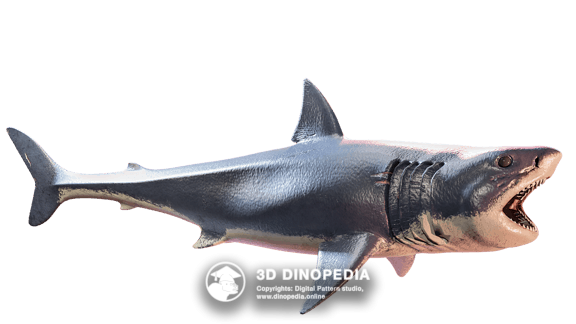
Megalodon was a marine giant that stood at the top of the oceanic food chain from 23 to 3 million years ago. It was a time when the seas teemed with life, and this predator had no equal.
Its teeth were found as early as antiquity, but people did not understand what they were. Medieval scholars called them «dragon tongues» or «petrified serpent tongues». Only in 1667 did the Danish naturalist Niels Stensen (better known as Steno) recognize that these enormous triangular fossils were the teeth of an ancient shark. Later, in 1835, the Swiss paleontologist Louis Agassiz gave the shark the name that became famous: Megalodon, meaning «big tooth».
The name proved fitting. Megalodon reached lengths of 15 to 24 meters and may have weighed up to 100 tons. To support such mass, its skeleton contained a high concentration of calcium, and its vertebral column formed a powerful, flexible structure that provided both strength and mobility. Its primary weapon, however, was its mouth: up to 276 teeth, each as long as 18 centimeters. These teeth could bite into bone and flesh with enormous force.
Scientists estimate that megalodon’s bite force ranged from 10 to 18 metric tons—approximately nine times stronger than that of a great white shark and six times more powerful than that of a modern saltwater crocodile. With a single bite, it could crush a whale’s rib cage or sever a dolphin’s spine.
The diet of this marine titan included nearly everything within its range: large fish and marine mammals such as sirenians, seals, and whales. Bite marks preserved on the bones of ancient cetaceans indicate that megalodon hunted prey comparable to itself in size.
Megalodons inhabited warm subtropical and temperate waters, preferring coastal seas rich in food. Around 3 million years ago, however, their dominance ended. Scientists suggest that ocean cooling reduced available prey, while the emergence of new competitors—faster and more agile great white sharks—added pressure. At the same time, toothed whales evolved to swim in coordinated groups and possessed higher cognitive abilities, enabling them to defend themselves and possibly prey upon juvenile megalodons.
Thus disappeared one of the most formidable predators in Earth’s history—the ruler of ancient seas, whose fossil teeth still evoke awe at a time when the oceans belonged to it.
Discussions
 Start a discussion

 0
0
 0
0
 353
353
Other animals




 INTERESTING FACTS
 PUZZLES
 HOME
HOME
 3D MODEL "SKIN"
 3D MODEL "MUSCLES"
 3D MODEL "SKELETON"
 VISION
 NEIGHBORS
 VOICE ACTING
 AR - MODE
 GALLERY
 HISTORY OF DISCOVERIES

