


Spinosaurus

Name meaning:
Spine lizard
Period of life:
99–94 mya
Period:
Cretaceous period
Habitat:
Mangrove forests and bayous
Taxonomy:
Theropods
Countries:






 Tylosaurus


Devil frog


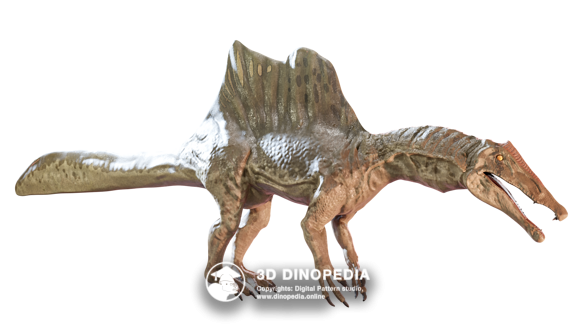
Spinosaurus was one of the most unusual predatory dinosaurs in terms of anatomy. It belonged to the family Spinosauridae and lived in what is now North Africa during the Cretaceous period, approximately 101–94 million years ago. Its first remains were discovered in Egypt, in the Bahariya Formation, and later fossils were also found in Morocco, Algeria, and Tunisia.
The history of Spinosaurus research illustrates how scientific understanding can change dramatically as new material is discovered. Early reconstructions depicted it as a typical terrestrial theropod walking on two legs. However, in 2020, paleontologists revised this view. New fossil evidence showed that Spinosaurus was a truly semi-aquatic predator, highly adapted to life in water.
A key discovery was a nearly complete tail. Its vertebrae possessed elongated neural spines, making the tail deep and laterally flexible, similar to the fin of a crocodile. This anatomy indicates that Spinosaurus used its tail for aquatic propulsion, generating powerful undulating movements like those of modern crocodilians or monitor lizards.
The most striking feature of Spinosaurus was its enormous dorsal sail — a tall bony structure reaching up to 1.7 meters in height. Its function remains debated. It may have helped regulate body temperature, served in display to intimidate rivals or attract mates, or functioned as a visual signal within the species.
The skull was equally distinctive — elongated, about 1.75 meters long, and resembling that of a crocodile. The jaws contained roughly 40 straight, conical teeth, perfectly adapted for grasping slippery prey. Although its bite force was likely weaker than that of Tyrannosaurus, it was well suited for quickly seizing fish — probably its primary food source. Spinosaurus likely hunted in rivers and shallow lagoons, occasionally venturing onto land to prey on reptiles or other animals near the water.
The size of Spinosaurus remains a subject of debate. Current estimates suggest a length of 14–15 meters and a mass between 7.5 and 9 tonnes, making it one of the largest known carnivorous dinosaurs — possibly even larger than Tyrannosaurus.
All four limbs were robust and equipped with claws: four toes on the hind feet and three fingers on the forelimbs. Its flexible tail served as the main propulsive organ in water. Spinosaurus represents a unique example of aquatic adaptation among dinosaurs — a theropod that fundamentally reshaped our understanding of what predatory dinosaurs could be.
Discussions
 Start a discussion

 0
0
 1
1
 93
93
Other animals



 INTERESTING FACTS
 PUZZLES
 HOME
HOME
 3D MODEL "SKIN"
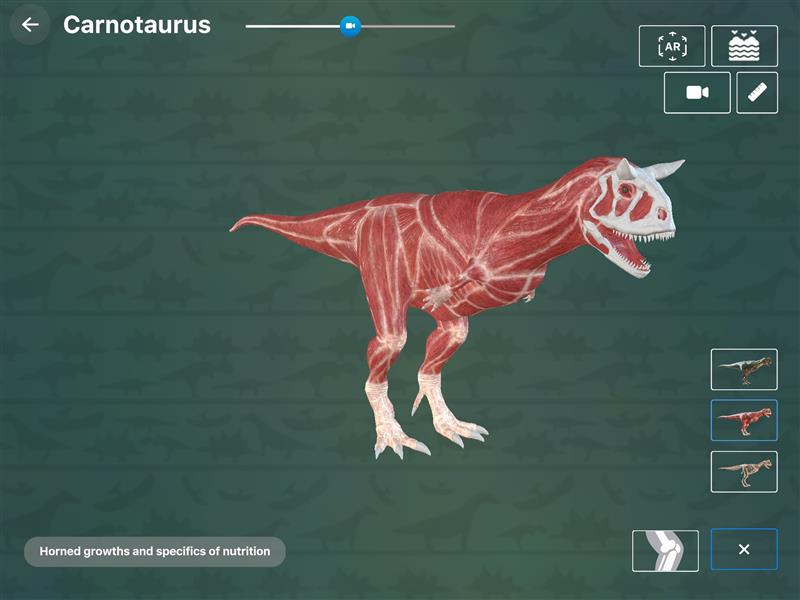
 3D MODEL "MUSCLES"
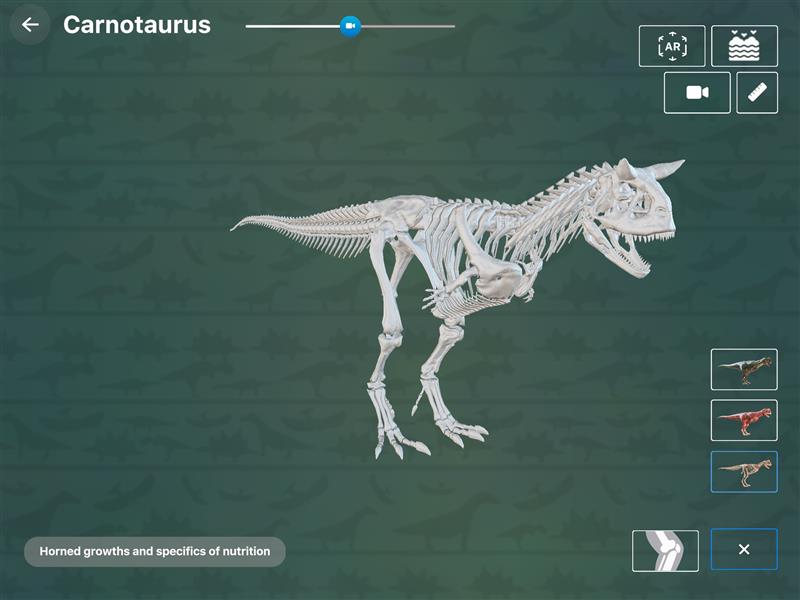
 3D MODEL "SKELETON"
 VISION
 NEIGHBORS
 VOICE ACTING
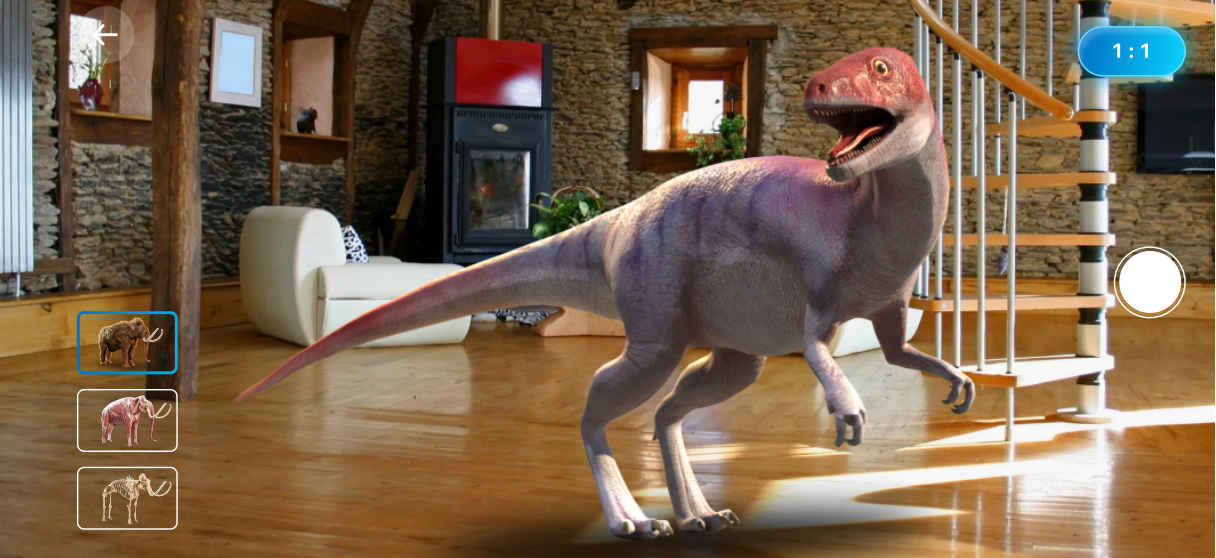
 AR - MODE
 GALLERY
 HISTORY OF DISCOVERIES

