


Gallimimus

Name meaning:
Rooster mimic
Period of life:
71-69 mya
Period:
Cretaceous period
Habitat:
Woodlands
Taxonomy:
Theropods
Countries:




 Carcharodontosaurus


Kosmoceratops


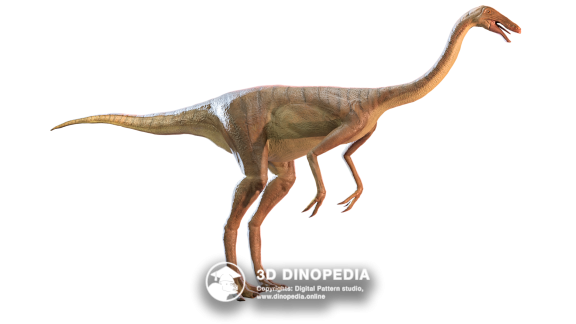
Gallimimus was one of the most remarkable dinosaurs of the Late Cretaceous. It lived about 70 million years ago in what is now Mongolia and belonged to the ornithomimid group, the so-called «bird-mimic» dinosaurs. Some individuals reached lengths of up to 6 meters, making Gallimimus one of the largest members of its family.
In appearance, Gallimimus indeed resembled a giant ostrich. It had a small head with large, round eyes, a toothless beak, a long neck, and powerful hind limbs adapted for fast running. The long tail helped maintain balance, swaying slightly from side to side during movement. The forelimbs were relatively long but not particularly strong, bearing three claws that the dinosaur likely used to grasp small objects or food items.
Based on some fossil evidence, Gallimimus, like other ornithomimids, was covered with feathers. This further enhanced its resemblance to modern ostriches and supports the view that many dinosaurs were endothermic.
Scientists continue to debate the exact diet of Gallimimus. Most researchers consider it to have been omnivorous. Its mobile neck would have allowed it to rapidly scan its surroundings while foraging. Another hypothesis suggests that certain features of its beak resemble a filtering apparatus similar to that of modern ducks, which could indicate that Gallimimus strained small food particles from water. Alternatively, these structures may have been used to process tough plant material, supporting a primarily herbivorous diet.
In any case, Gallimimus was a light, fast, and likely very cautious dinosaur, whose behavior may have been comparable to that of modern ostriches in open environments such as savannas.
Discussions
Start the first one!
 Start a discussion
Other animals



 INTERESTING FACTS
 PUZZLES
 HOME
HOME
 3D MODEL "SKIN"
 3D MODEL "MUSCLES"
 3D MODEL "SKELETON"
 VISION
 NEIGHBORS
 VOICE ACTING
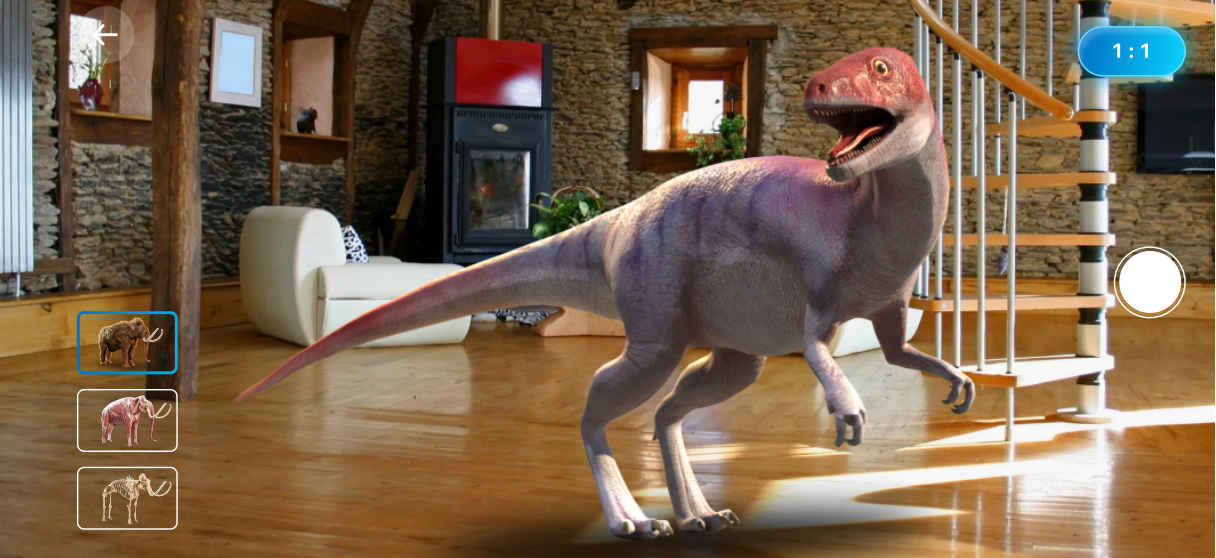
 AR - MODE
 GALLERY
 HISTORY OF DISCOVERIES

