


Mixosaurus

Name meaning:
Mixed lizard
Period of life:
250–240 mya
Period:
Triassic period
Habitat:
Marine environment
Taxonomy:
Marine reptiles
Countries:






 Cyamodus


Silesaurus


What does the name mean: “Mixed lizard”
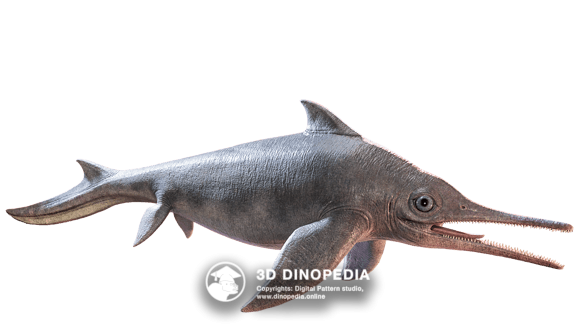
Mixosaurus is an extinct genus of ichthyosaurs that thrived during the Middle Triassic, approximately 250–240 million years ago. Its fossils have been discovered in many parts of the world, including Italy, Switzerland, China, Timor, Canada, and the United States (Alaska and Nevada), indicating that this genus was widely distributed across ancient seas.
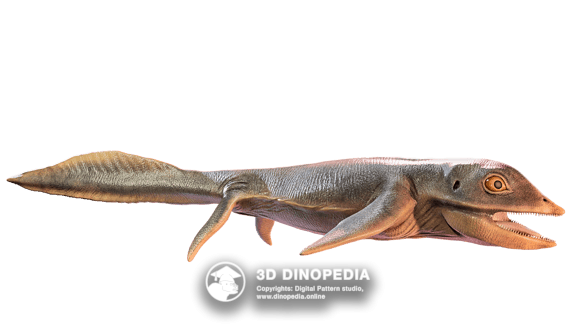
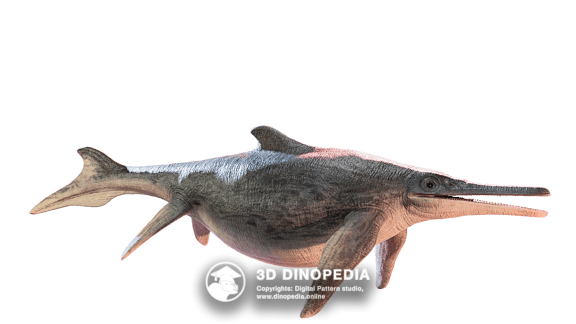
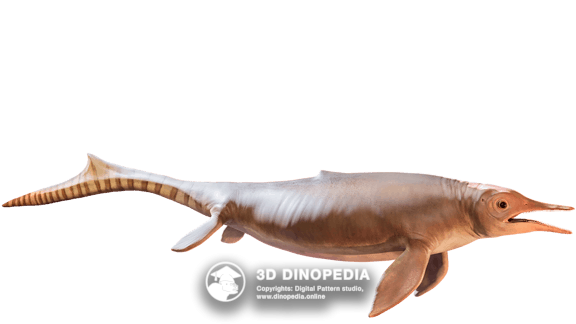
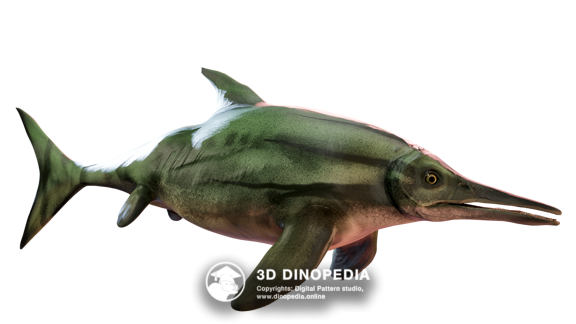
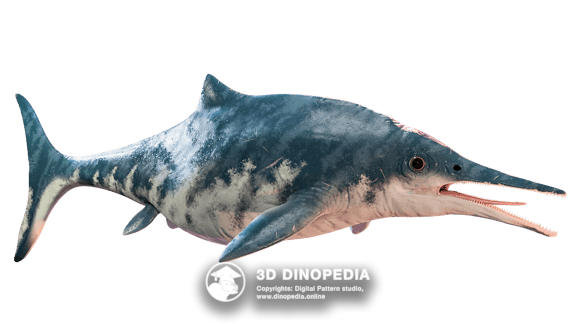
Mixosaurus species were generally small ichthyosaurs, measuring about 73 to 100 cm in length and weighing between 2.2 and 5.7 kg. Some individuals, however, reached up to 2 meters in length. Their bodies were streamlined, with a long tail ending in a relatively low tail fin. This suggests that Mixosaurus was not as fast a swimmer as later Jurassic ichthyosaurs. Nevertheless, the presence of a dorsal fin would have provided stability in the water.
The paddle-like limbs of Mixosaurus differed from those of more advanced ichthyosaurs. Each limb had five digits, whereas later ichthyosaurs often had five or more. Interestingly, each digit contained an increased number of bones compared to typical reptiles. The forelimbs were longer than the hindlimbs, a feature that foreshadows adaptations seen in later ichthyosaurs.
Its narrow jaws were equipped with sharp teeth, well suited for catching fish, indicating a predatory lifestyle. The skull was relatively large compared to the body, distinguishing Mixosaurus from more primitive ichthyosaurs.
Mixosaurus possessed about 50 vertebrae in front of the pelvic girdle—roughly twice as many as in terrestrial reptiles—reflecting significant adaptation to aquatic life. Recent studies suggest that it likely inhabited coastal waters or shallow marine environments, based on bone structure characteristics typical of animals living in such habitats.
Currently, three species are recognized: Mixosaurus cornalianus, Mixosaurus xindianensis, and Mixosaurus kuhnschnyderi. While they share many features, they differ in aspects such as tooth structure.
Discussions
Start the first one!
 Start a discussion
Other animals




 INTERESTING FACTS
 PUZZLES
 HOME
HOME
 3D MODEL "SKIN"
 3D MODEL "MUSCLES"
 3D MODEL "SKELETON"
 VISION
 NEIGHBORS
 VOICE ACTING
 AR - MODE
 GALLERY
 HISTORY OF DISCOVERIES

