


Araripesuchus
Name meaning:
Crocodile from the Araripe
Period of life:
125–66 million years ago
Period:
Cretaceous period
Habitat:
Coasts
Taxonomy:
Crocodilians
Countries:






 Polacanthus


Nipponosaurus


What does the name mean: The genus name Araripesuchus comes from the Araripe region of Brazil, where the first fossils were discovered, and the Greek word souchos — “crocodile.”
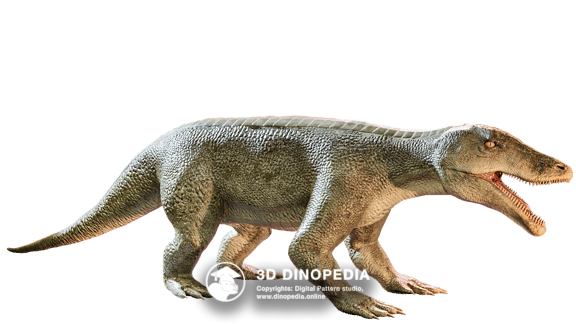
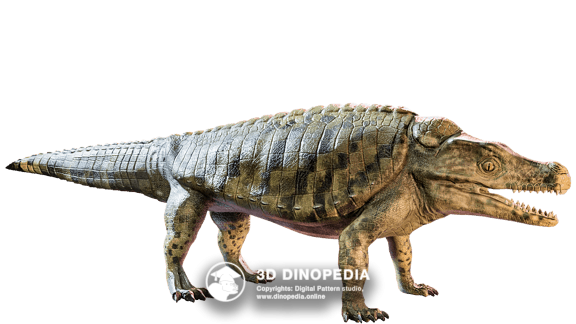
Araripesuchus was an extinct genus of crocodylomorphs that lived during the Cretaceous Period, approximately 125–66 million years ago. Its representatives were widely distributed across the supercontinent Gondwana: fossils have been found in present-day Brazil, Argentina, Morocco, Madagascar, and other regions of Africa, including Niger and Cameroon.
Unlike most modern crocodilians, Araripesuchus species were primarily terrestrial animals. Their body length was usually about 1 m, although some species reached 1–1.8 m. The structure of the limbs — relatively long legs and a more elevated body posture — indicates an active lifestyle and the ability to move quickly on land. In body proportions, they somewhat resembled small terrestrial predators. Juvenile individuals possessed proportionally longer limbs than adults, which is also consistent with high mobility.
The skull of Araripesuchus possessed several distinctive features. The snout was relatively short and narrow, comprising about half of the skull length. The eye sockets and temporal fenestrae, which served as attachment sites for jaw musculature, were large. The external nostrils were positioned at the front end of the snout and faced forward rather than upward, a condition more typical of terrestrial animals than semi-aquatic ones.
The dentition of Araripesuchus, as in many notosuchians, was heterodont, meaning the teeth differed in shape and function. The anterior teeth were simple and conical, whereas the posterior teeth were often leaf-shaped, with pronounced ornamentation and serrated edges. Wear patterns on the enamel and the tight occlusion of the tooth rows indicate the ability to actively process food within the mouth, which is unusual among crocodylomorphs.
The feeding ecology of Araripesuchus remains debated. In some species, such as Araripesuchus wegeneri, the teeth are divided into three functional types — incisor-like, canine-like, and molar-like — resembling the differentiation seen in mammals. This suggests complex food processing and supports the possibility of an omnivorous diet that may have included plant material.
Some researchers have proposed a predominantly herbivorous lifestyle, but convincing evidence for strict herbivory has not been found. The diet probably also included insects and small vertebrates. Other species of the genus possessed different dental morphologies, indicating a diversity of feeding strategies ranging from more plant-oriented forms to small predators and omnivores.
The study of Araripesuchus is important for understanding the evolution of crocodylomorphs and their adaptations to different habitats. These relatively small terrestrial forms demonstrate the remarkable diversity of crocodylomorphs during the Cretaceous Period: from active runners with complex dentitions to more typical semi-aquatic representatives. Araripesuchus illustrates how the ancestors of modern crocodilians colonized terrestrial environments and evolved a variety of ecological niches.
Discussions
Start the first one!
 Start a discussion
Other animals




 INTERESTING FACTS
 PUZZLES
 HOME
HOME
 3D MODEL "SKIN"
 3D MODEL "MUSCLES"
 3D MODEL "SKELETON"
 VISION
 NEIGHBORS
 VOICE ACTING
 AR - MODE
 GALLERY
 HISTORY OF DISCOVERIES

