


Leptictidium


Name meaning:
Small Leptictis
Period of life:
50–35 million years ago
Period:
Paleogene period
Habitat:
Rainforests
Taxonomy:
Mammals
Countries:





 Megalampris


Megalodon



What does the name mean: “small Leptictis” (Leptictis being an ancient Eocene mammal from North America).
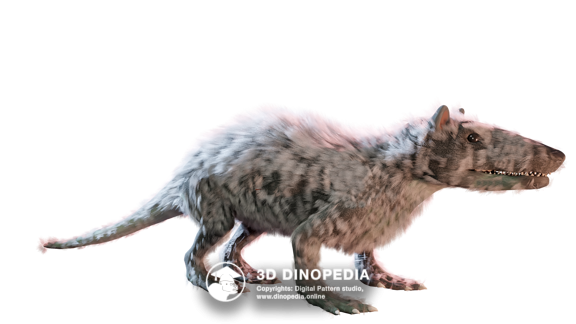
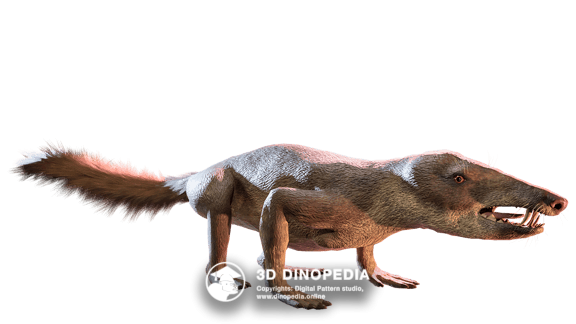
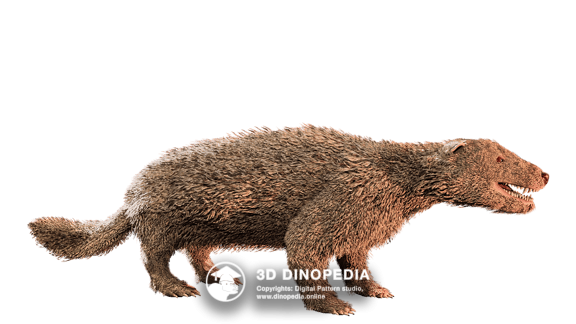
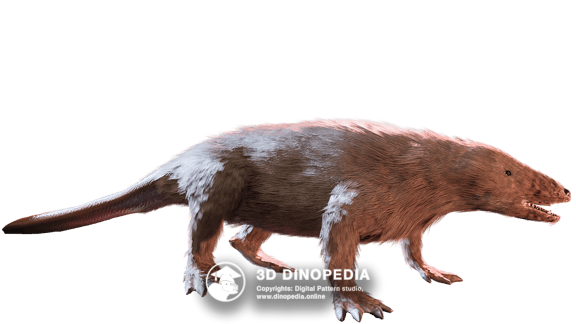
Leptictidium tobieni is an extinct genus of small mammals that appeared about 50 million years ago during the early Eocene. This period was characterized by a warm and humid climate that supported the development of dense forest ecosystems. Leptictidium was widespread across Europe and inhabited mainly subtropical forests. It disappeared around 35 million years ago, at the beginning of the Oligocene, when the climate became cooler and drier, leading to the reduction of forest habitats.
In several respects, Leptictidium can be compared with modern bilbies, bandicoots, and elephant shrews, occupying a broadly similar ecological niche. However, its anatomy combined both primitive and specialized features. The forelimbs were relatively short, whereas the hind limbs were elongated and powerful, indicating an ability for hopping locomotion. The long tail probably served as a balancing organ. A distinctive feature of the forelimbs was the elongated third finger, which may have been used while searching for food.
The body length of Leptictidium was about 60–90 cm, with more than half of this length formed by the tail. Height reached approximately 40 cm, while body mass probably did not exceed 1 kg. Such small size allowed it to avoid large predators and exploit a variety of food sources.
Leptictidium possessed an elongated and mobile snout, which facilitated searching for food within forest litter. Its diet included insects, lizards, amphibians, and small mammals. Omnivory provided flexibility in food selection, although climatic and environmental changes may have contributed to its extinction.
The hind limbs of Leptictidium were especially developed in the distal regions, including the feet. Their structure indicates adaptation for hopping locomotion; however, analysis of the joints suggests that they may not have been stable enough for prolonged impact loads. It is therefore assumed that the animal usually moved on all four limbs, using hopping only occasionally. Weak fixation of the joints, including the ankle and sacroiliac joints, provided increased mobility. The molars possessed a complex structure adapted for processing varied food.
Several species of the genus Leptictidium have been described. Leptictidium tobieni, discovered in Germany at the Messel Pit, was the largest representative and reached 75–90 cm in length. Leptictidium nasutum, also known from Messel, differed in its elongated narrow snout; its species name means “long-nosed.”
Leptictidium is important for paleontology as an early eutherian mammal, probably outside or close to the crown group of modern placental mammals. It demonstrates a combination of archaic and specialized features, helping researchers trace the evolutionary patterns of early mammals during periods of climatic change.
Discussions
Start the first one!
 Start a discussion
Other animals














 INTERESTING FACTS
 PUZZLES
 HOME
HOME
 3D MODEL "SKIN"
 3D MODEL "MUSCLES"
 3D MODEL "SKELETON"
 VISION
 NEIGHBORS
 VOICE ACTING
 AR - MODE
 GALLERY
 HISTORY OF DISCOVERIES

