


Gomphotherium

Name meaning:
Beast with peg-like tusks
Period of life:
19.5–2.6 million years ago
Period:
Neogene period
Habitat:
Floodplains
Taxonomy:
Mammals
Countries:






 Argentavis


Odobenocetops


What does the name mean: Gomphotherium means “peg beast” or “nail beast” (from Ancient Greek gomphos — “nail,” “peg,” “bolt” and therion — “beast”). The name can be approximately translated as “beast with peg-like tusks (or teeth).”
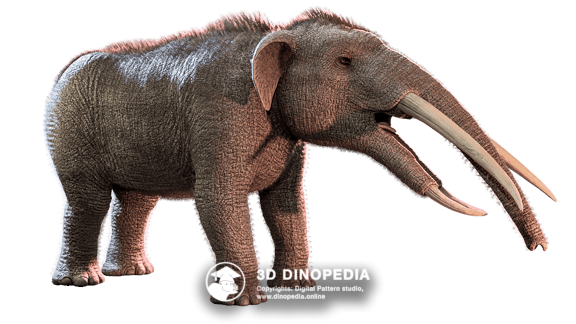
Gomphotherium steinheimense was a representative of the extinct family Gomphotheriidae within the order Proboscidea. These animals lived from the middle Miocene to the early Pliocene, approximately 19.5–2.6 million years ago. They were widely distributed across Eurasia, Africa, and North America.
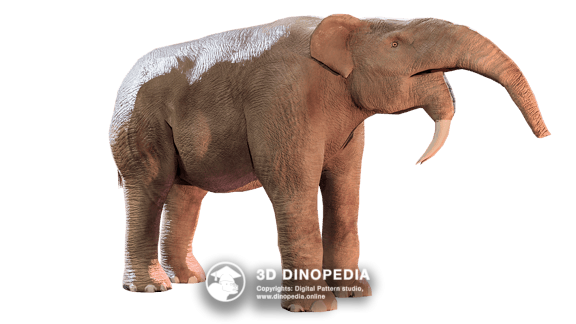
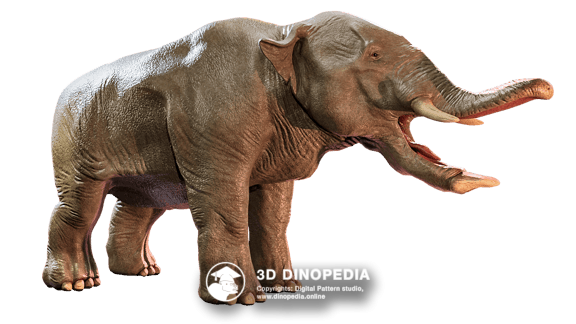
Gomphotheres were large animals. Most species were comparable in size to the modern Asian elephant, standing about 2.5 m at the shoulder and weighing around 4–5 tonnes. The largest forms reached about 3.2 m in shoulder height and weighed up to 6–7 tonnes, with body lengths of approximately 5–6 m. The body was massive, supported by column-like limbs ending in broad feet with five toes, each bearing a small hoof-like nail. The tail was probably relatively long, thick at the base, and gradually tapering toward the end.
A characteristic feature of gomphotheres was the presence of four tusks — two upper and two lower. The upper tusks grew from the upper jaw and were long and curved; a longitudinal enamel band ran along their outer surface, increasing their strength. The lower tusks were shorter and straighter, positioned on an elongated lower jaw and directed forward almost parallel to each other. This structure gave the lower jaw a shovel-like appearance.
The head was elongated and relatively low. Gomphotheres possessed a trunk that was probably shorter and less flexible than that of modern elephants. It was used to grasp leaves and shoots, as well as to collect water. The molars had a bunodont (cusped) surface adapted for grinding plant material.
Paleontological evidence suggests that gomphotheres preferred forested regions near water bodies, where their remains are most commonly found. The study of these animals is important for understanding the evolution of proboscideans and their phylogenetic relationships. Gomphotheres occupy a key place in the history of the order, allowing researchers to trace gradual morphological changes over millions of years.
Discussions
Start the first one!
 Start a discussion
Other animals







 INTERESTING FACTS
 PUZZLES
 HOME
HOME
 3D MODEL "SKIN"
 3D MODEL "MUSCLES"
 3D MODEL "SKELETON"
 VISION
 NEIGHBORS
 VOICE ACTING
 AR - MODE
 GALLERY
 HISTORY OF DISCOVERIES

