


Hyaenodon
Name meaning:
Hyena tooth
Period of life:
42–16 million years ago
Period:
Neogene period
Habitat:
Rainforests
Taxonomy:
Mammals
Countries:





 Megalampris


Megalodon


What does the name mean: «hyena tooth».
Hyaenodon was a large predator that inhabited Eurasia and North America from the Middle Eocene to the Early Miocene (approximately 42–16 million years ago).
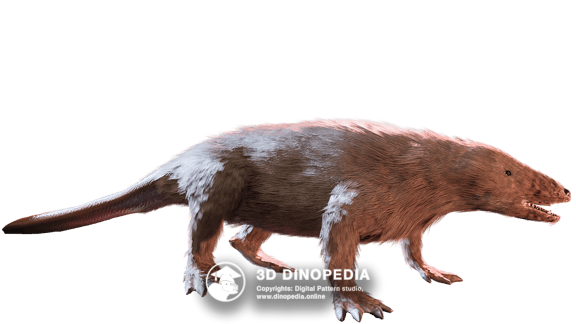
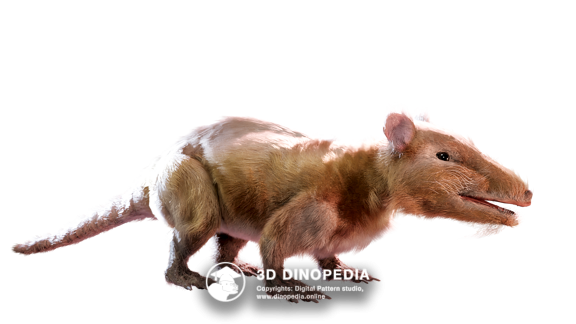
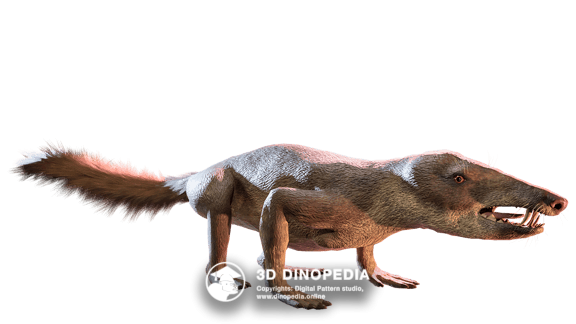
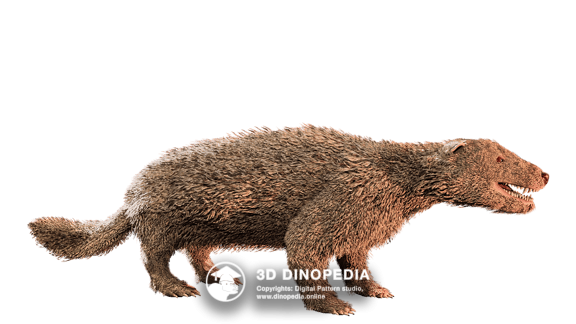
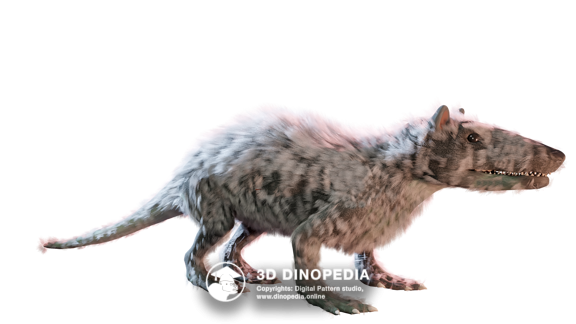
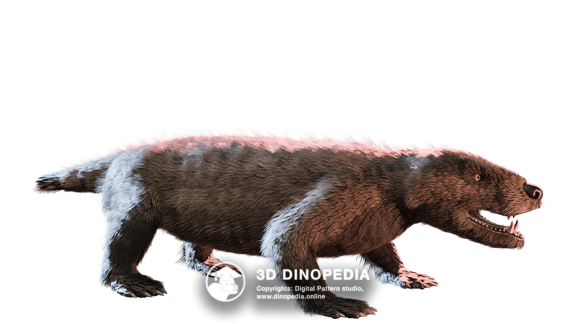
Hyaenodon possessed a relatively large skull compared with its body size — a feature that makes it difficult to compare directly with modern predators. Its snout was long and dog-like, though more elongated, and its jaws were powerful. The teeth of Hyaenodon, unlike those of modern hyenas (Hyaenidae), were adapted not for crushing bones but for slicing meat. They were highly effective at processing soft tissues. However, microwear traces indicate that some species may also have consumed denser structures such as tendons and possibly bones.
An unusual feature of Hyaenodon was the lateral placement of the eyes on the sides of the skull — more similar to herbivores than to most modern predators, whose eyes face forward. Nevertheless, this did not prevent successful hunting, although binocular vision was probably comparatively weakly developed.
The body of Hyaenodon was long and muscular, supported by strong limbs. Depending on the species, body size ranged from small forms approximately the size of a marten to very large species exceeding the size of modern tigers.
Hyaenodon was well adapted to a predatory lifestyle. Its anatomy allowed it to pursue, knock down, and tear apart prey such as primitive horses, camels, rhinoceroses, and other herbivores. However, its massive build probably limited its ability for sustained running. Most likely, these animals were ambush predators that pursued prey over short distances — a hunting strategy similar to that of many modern cats. It may be assumed that Hyaenodon occupied ecological niches comparable to those of various members of the cat family (Felidae). Like other representatives of its group, it was a highly specialized predator. Although it may occasionally have consumed carrion, active hunting remained the basis of its diet. Judging from skeletal structure, Hyaenodon was capable of bringing down relatively large prey.
The study of Hyaenodon fossils helps scientists reconstruct ancient ecosystems, trace the evolution of mammals, and understand how natural communities changed over millions of years.
Discussions
Start the first one!
 Start a discussion
Other animals







 INTERESTING FACTS
 PUZZLES
 HOME
HOME
 3D MODEL "SKIN"
 3D MODEL "MUSCLES"
 3D MODEL "SKELETON"
 VISION
 NEIGHBORS
 VOICE ACTING
 AR - MODE
 GALLERY
 HISTORY OF DISCOVERIES

