


Triceratops

Name meaning:
Three-horned face
Period of life:
68–66 mya
Period:
Cretaceous period
Habitat:
Mangrove forests and bayous
Taxonomy:
Marginocephalians
Countries:





 Quetzalcoatlus


Tyrannosaurus


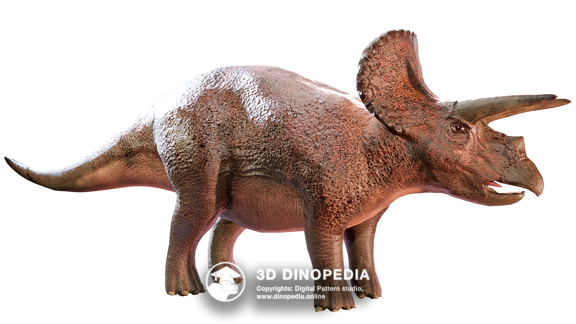
Triceratops is one of the most iconic representatives of the horned ceratopsians. These herbivores inhabited the plains of North America at the end of the Late Cretaceous, approximately 68–66 million years ago, when the planet stood on the brink of mass extinction.
The first fragments of Triceratops were discovered in 1887, and since then numerous remains have been found, although a completely articulated skeleton remains rare. Only in 1994 was one of the most complete specimens presented, though only its right side was preserved.
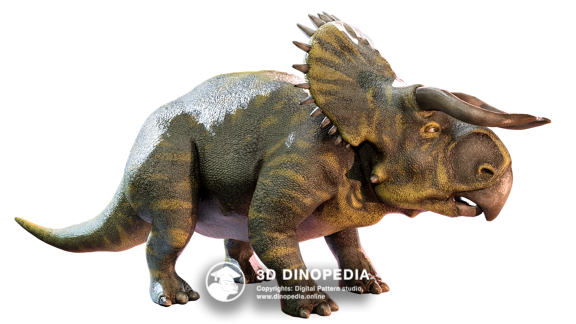
The body of Triceratops was covered with thick, scaly skin, and its most distinctive features were the enormous horns and the bony frill surrounding the neck. Two long horns projected above the eyes, while a shorter horn was positioned on the nose. These impressive “three horns” likely served dual functions: defense against predators and use in intraspecific combat, particularly between males during the breeding season. The skull reached up to two meters in length and accounted for nearly one-third of the total body length, which measured 6–8 meters. Adult mass is estimated at 7–10 tonnes, with a shoulder height of about three meters.
Triceratops moved on robust limbs—shorter forelimbs and longer hind limbs—resulting in a stable, somewhat heavy gait comparable to that of a modern rhinoceros.
This giant fed on low-growing vegetation such as ferns, horsetails, and early angiosperms. A narrow, beak-like rostrum clipped leaves and stems, which were then processed by powerful dental batteries. Each individual possessed around 80 functional teeth at a time, continuously replaced throughout life; over a lifetime, up to 800 teeth could be replaced, forming an efficient biological system for processing fibrous plant material.
Triceratops remains a symbol of the Late Cretaceous world—one of the last great giants of the dinosaur era. Its armor, horns, and massive build embodied strength and resilience—traits that did not prevent its extinction but secured its enduring place in the history of life on Earth.
Discussions
Start the first one!
 Start a discussion
Other animals



 INTERESTING FACTS
 PUZZLES
 HOME
HOME
 3D MODEL "SKIN"
 3D MODEL "MUSCLES"
 3D MODEL "SKELETON"
 VISION
 NEIGHBORS
 VOICE ACTING
 AR - MODE
 GALLERY
 HISTORY OF DISCOVERIES

