


Astrapotherium

Name meaning:
Lightning beast
Period of life:
18—15,2 million years ago
Period:
Neogene period
Habitat:
Savannas and plains
Taxonomy:
Mammals
Countries:





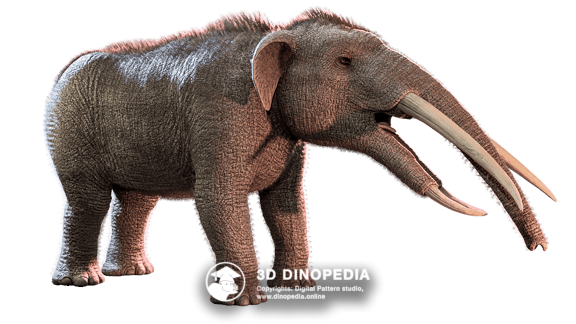 Gomphotherium


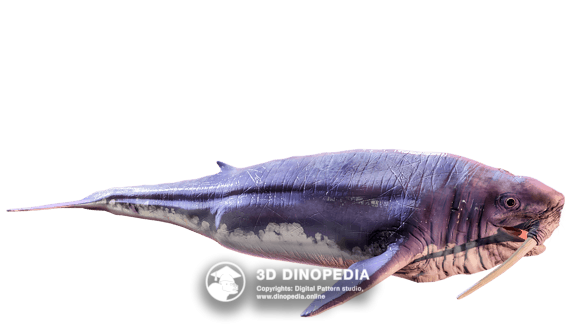
Odobenocetops


What does the name mean: The name Astrapotherium comes from the Greek ἀστραπή (astrapē) — “lightning” and θηρίον (thērion) — “beast,” and can be translated as “lightning beast”.
Around 18 million years ago, giant mammals with unusual body structures lived in South America. During this period, evolution produced a wide variety of distinctive life forms. Among them was Astrapotherium — a large animal combining features reminiscent of both elephants and hippopotamuses.
Astrapotherium lived during the Miocene, an epoch characterized by warm climates and active mammalian evolution. These were large herbivorous animals reaching up to 2.5 m in length and weighing as much as 1,500 kg, comparable in size to modern African hippopotamuses or small Asian elephants.
One of the most characteristic features of Astrapotherium was its skull, measuring 60–80 cm in length. It possessed large downward-pointing tusk-like canines reminiscent of those of hippopotamuses, as well as a shortened snout that likely supported a small proboscis.
The limb structure of Astrapotherium was also unusual. The forelimbs were shorter and more massive than the hind limbs, while the feet were five-toed and ended in hoof-like structures. The forefeet were digitigrade, whereas the hind feet were plantigrade, giving the animal a distinctive gait. Its massive body was well adapted for movement across swampy terrain.
According to one hypothesis, Astrapotherium may have led a semiaquatic lifestyle similar to that of modern hippopotamuses, inhabiting areas near water bodies and humid forests. This interpretation is supported by its barrel-shaped body and the possibly elevated position of the nostrils. However, isotopic evidence remains inconclusive, and some researchers consider the semiaquatic interpretation uncertain.
The dentition of Astrapotherium displayed several distinctive features. The upper incisors were strongly reduced or absent, while the lower incisors were procumbent — projecting almost horizontally forward. Such a structure may have been useful for digging up roots and tubers or pulling up low-growing vegetation rather than browsing on tree branches.
Despite their large size, Astrapotherium were probably relatively calm animals. Males, which were larger and possessed more developed tusk-like canines, may have used them in mating contests for access to females.
Like many other representatives of the Miocene megafauna, Astrapotherium became extinct around 10 million years ago. The exact causes of its extinction remain a subject of scientific debate.
Discussions
Start the first one!
 Start a discussion
Other animals






 INTERESTING FACTS
 PUZZLES
 HOME
HOME
 3D MODEL "SKIN"
 3D MODEL "MUSCLES"
 3D MODEL "SKELETON"
 VISION
 NEIGHBORS
 VOICE ACTING
 AR - MODE
 GALLERY
 HISTORY OF DISCOVERIES

