


Rhamphorhynchus

Name meaning:
Beak snout
Period of life:
151-149 mya
Period:
Jurassic period
Habitat:
Coasts
Taxonomy:
Pterosaurs
Countries:





 Allosaurus


Kentrosaurus


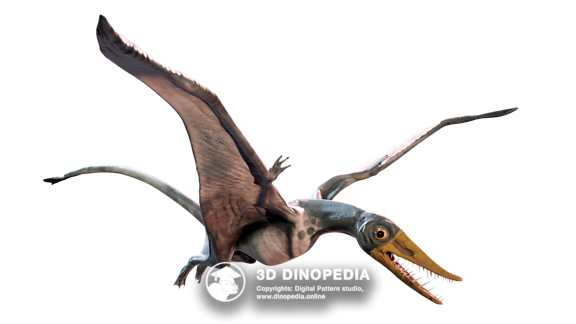
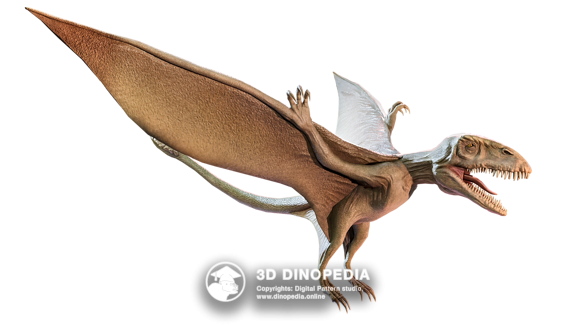
Rhamphorhynchus was one of the most recognizable ancient pterosaurs. This flying reptile, with a long tail and narrow wings, soared through the skies in the Late Jurassic, about 151–148 million years ago. It dominated the air above what are now the United Kingdom, Germany, Spain, Portugal, and Tanzania, where warm coastal seas extended at that time.
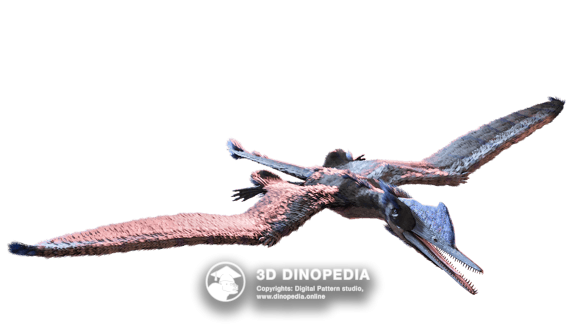
Rhamphorhynchus had an elongated skull with a pointed snout. Its upper jaw bones formed a beak-like structure, and its long, sharp teeth, projecting forward, were perfectly suited for catching slippery fish. When it seized prey, the teeth acted like hooks, preventing the victim from escaping. Rhamphorhynchus lacked a crest, and its wings were leathery membranes stretched between the elongated fourth finger, the body, and the hind limbs.
Although fish formed the basis of its diet, Rhamphorhynchus probably did not refuse other prey. It may have searched for larvae in tree bark or fed on the eggs of animals found in coastal sand.
Rhamphorhynchus lived mainly near water, along the shores of lakes and seas, among rocks and coastal cliffs. It may have nested in colonies, like modern seabirds.
Sometimes it is suggested that birds or bats evolved from such animals, but this is not correct. Rhamphorhynchus was a reptile, whereas bats are mammals. They developed along different branches of the evolutionary tree. Their similarity is an example of convergence, when unrelated groups independently evolve similar forms due to comparable lifestyles—in this case, flight.
Discussions
Start the first one!
 Start a discussion
Other animals










 INTERESTING FACTS
 PUZZLES
 HOME
HOME
 3D MODEL "SKIN"
 3D MODEL "MUSCLES"
 3D MODEL "SKELETON"
 VISION
 NEIGHBORS
 VOICE ACTING
 AR - MODE
 GALLERY
 HISTORY OF DISCOVERIES

