


Odobenocetops

Name meaning:
Walrus-like whale
Period of life:
9,6–4,5 million years ago
Period:
Neogene period
Habitat:
Marine environment
Taxonomy:
Mammals
Countries:





 Gomphotherium


Megatherium


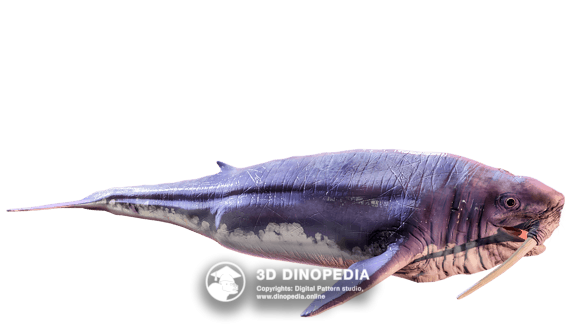
What does the name mean: The genus name Odobenocetops is derived from Odobenus (walrus), the Latin cetus — “whale,” and the Greek ops — “appearance, form,” and can be translated as “a cetacean with the appearance of a walrus.”
Odobenocetops is a genus of extinct toothed whales that lived during the Late Miocene, approximately 9.6–4.5 million years ago. Their remains are known from coastal deposits of Peru and Chile. These were relatively small cetaceans: body Length reached 3–4 m, and body mass was approximately 1 t. They were distinguished by an unusual external appearance.
Odobenocetops possessed a short rounded head resembling that of a walrus. Two large tusks projected from the upper jaw, with the right tusk being considerably longer than the left and reaching approximately 1.3 m in length. The tusks, composed of dentin, were probably used for obtaining food on the seafloor, including loosening sediment and extracting mollusks, and may also have played a role in social behavior.
Scientists have identified two species of Odobenocetops: Odobenocetops peruvianus and Odobenocetops leptodon. They differed slightly in head anatomy and probably in how they found food.
In O. peruvianus, the melon—a fatty organ in the head that helps modern toothed whales use echolocation—was almost absent. Its eyes, however, faced more forwards and upwards, giving it a better view of the area in front of it while feeding.
O. leptodon probably retained a small melon, while its eyes faced more towards the sides. This species may have relied more on echolocation, whereas O. peruvianus may have depended more on vision.
Both species may have had sensitive whiskers, known as vibrissae, on their snouts, much like those of a walrus. These may have helped them find food on the seafloor.
The body of Odobenocetops was typical of toothed whales: streamlined, with a flexible spine and a powerful tail. Unlike most cetaceans, it probably retained a relatively mobile neck, allowing effective use of the tusks during feeding.
The jaws of Odobenocetops lacked teeth except for the tusks. These features indicate a specialized feeding strategy associated with benthic foraging.
Odobenocetops were bottom-dwelling animals that probably fed on mollusks. They became extinct at the end of the Miocene, although the causes of their disappearance remain unclear. This genus represents an example of specialized adaptation of cetaceans to a benthic Lifestyle.
Discussions
Start the first one!
 Start a discussion
Other animals







 INTERESTING FACTS
 PUZZLES
 HOME
HOME
 3D MODEL "SKIN"
 3D MODEL "MUSCLES"
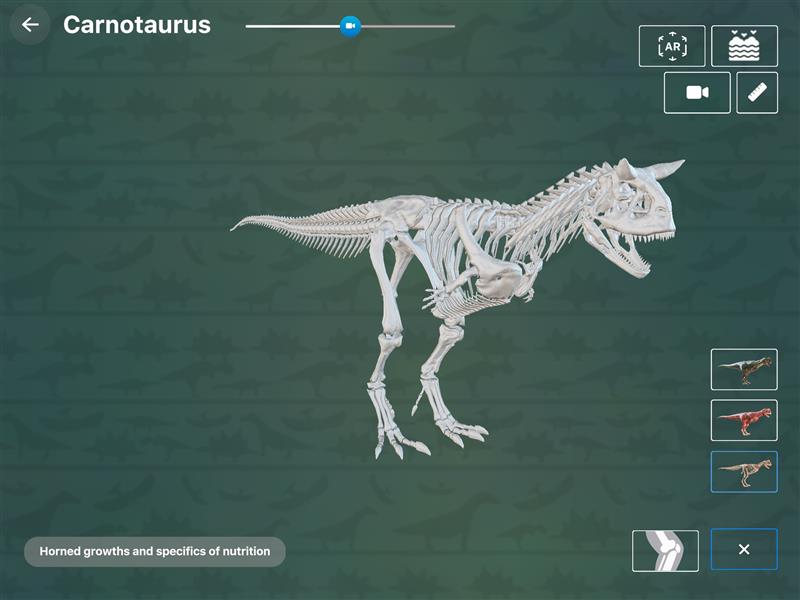
 3D MODEL "SKELETON"
 VISION
 NEIGHBORS
 VOICE ACTING
 AR - MODE
 GALLERY
 HISTORY OF DISCOVERIES

