


Steropodon
Name meaning:
Lightning tooth
Period of life:
100,2–96,6 million years ago
Period:
Cretaceous period
Habitat:
Lakes and marshes
Taxonomy:
Mammals
Countries:



 Bajadasaurus


Andrewsarchus


What does the name mean: “Lightning tooth”
During the first half of the Cretaceous period, around 100 million years ago, the territory of modern Australia lay at high southern latitudes near the South Pole. Here stretched the Eromanga inland sea, surrounded by forests. Despite the high latitude, the climate was relatively mild, and during certain parts of the year prolonged daylight occurred. In these conditions lived a small mammal resembling modern monotremes.
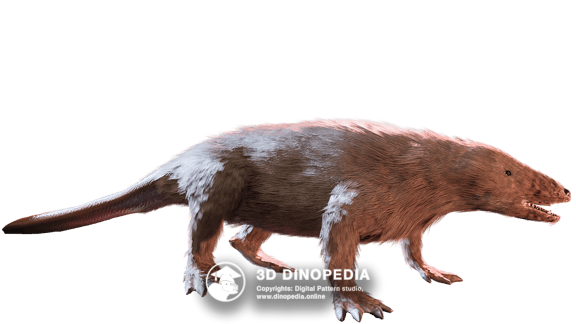
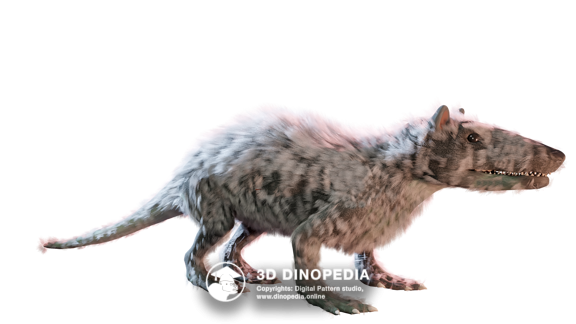
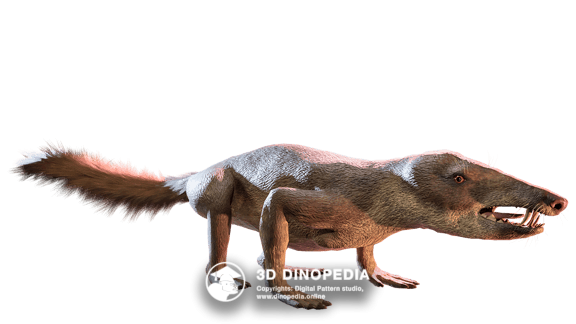
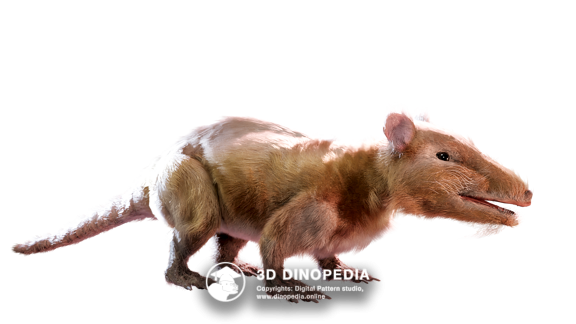
In reconstructions, Steropodon galmani is often depicted as resembling a platypus, with a bill-like snout and a semi-aquatic lifestyle. It is suggested that it may have fed on aquatic organisms. However, such reconstructions remain hypothetical, since only a fragment of the lower jaw with three molar teeth is known for this animal.
The fossil was discovered in the Griman Creek Formation at Lightning Ridge, New South Wales, Australia, by brothers David and Alan Galman. The jaw structure resembles that of modern monotremes. Steropodon galmani belongs to the monotremes — egg-laying mammals. Its molars, measuring about 5–7 mm in length and 3–4 mm in width, are considerably larger than the teeth of most Mesozoic mammals (usually 1–2 mm) and were probably adapted for feeding on aquatic organisms.
Based on the size of the jaw, it is estimated that Steropodon reached about 40–50 centimeters in length, making it a relatively large mammal for its time. Fossils of small vertebrates are rarely well preserved, which complicates the discovery of additional material. Today, Steropodon is considered one of the oldest known mammals from Australia.
Monotremes already represented an ancient branch of mammals during the Cretaceous. Modern classification recognizes three main mammalian groups: monotremes (including Steropodon as well as modern platypuses and echidnas), marsupials, and placental mammals.
Monotremes belong to the ancient lineage of prototherians and retain a number of primitive traits, including egg-laying. Marsupials and placental mammals belong to the more derived therian mammals and are characterized by live birth. All modern mammals share a common ancestor that lived approximately 190–180 million years ago.
Discussions
Start the first one!
 Start a discussion
Other animals






 INTERESTING FACTS
 PUZZLES
 HOME
HOME
 3D MODEL "SKIN"
 3D MODEL "MUSCLES"
 3D MODEL "SKELETON"
 VISION
 NEIGHBORS
 VOICE ACTING
 AR - MODE
 GALLERY
 HISTORY OF DISCOVERIES

