


Megalania

Name meaning:
Great wanderer
Period of life:
2.6 million – 50 thousand years ago
Period:
Quaternary period
Habitat:
Savannas and plains
Taxonomy:
Lizards and snakes
Countries:




 Arctodus


Hydrodamalis gigas



What does the name mean: "Great Wanderer"
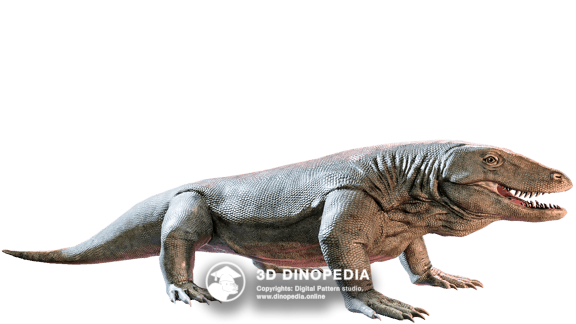
Megalania was an extinct species of giant monitor lizard that formed part of the unique megafauna of Pleistocene Australia. It is considered the largest terrestrial lizard ever known, although determining its exact size is difficult because the fossil remains are fragmentary. Current estimates suggest that Megalania may have reached lengths of 3.5 to 7 meters, though many scientists today question the highest estimates. Depending on the reconstruction, its body mass may have ranged from roughly 97 to 1,940 kilograms. Its body structure was typical of monitor lizards: an elongated muscular body, powerful limbs armed with sharp claws, and a long tail.
Paleontologists estimate the movement speed of Megalania at around 2.6–3 meters per second. This is comparable to the speed of a modern Australian crocodile. However, unlike crocodiles, monitor lizards possess far greater endurance, so Megalania was probably capable of maintaining such speed over longer distances.
The skull of Megalania was large and robust. A small crest was located between the eyes, while the powerful jaws carried serrated teeth shaped like blades. Like modern monitor lizards, Megalania possessed venom glands in the lower jaw, making its bite especially dangerous. Its internal anatomy reflected an active lifestyle: well-developed lungs, a strong heart, and an efficient circulatory system allowed this predator to maintain high levels of mobility and stamina.
Megalania occupied the role of apex predator within its ecosystem. It hunted a wide variety of animals, including birds, reptiles, and even giant marsupials such as Diprotodon, whose mass could exceed three tons.
The species became extinct relatively recently, around 50,000 years ago. The exact causes of its extinction remain uncertain, but possible factors include climatic changes and the arrival of the first humans in Australia.
Discussions
 Start a discussion

 0
0
 2
2
 356
356
Other animals



 INTERESTING FACTS
 PUZZLES
 HOME
HOME
 3D MODEL "SKIN"
 3D MODEL "MUSCLES"
 3D MODEL "SKELETON"
 VISION
 NEIGHBORS
 VOICE ACTING
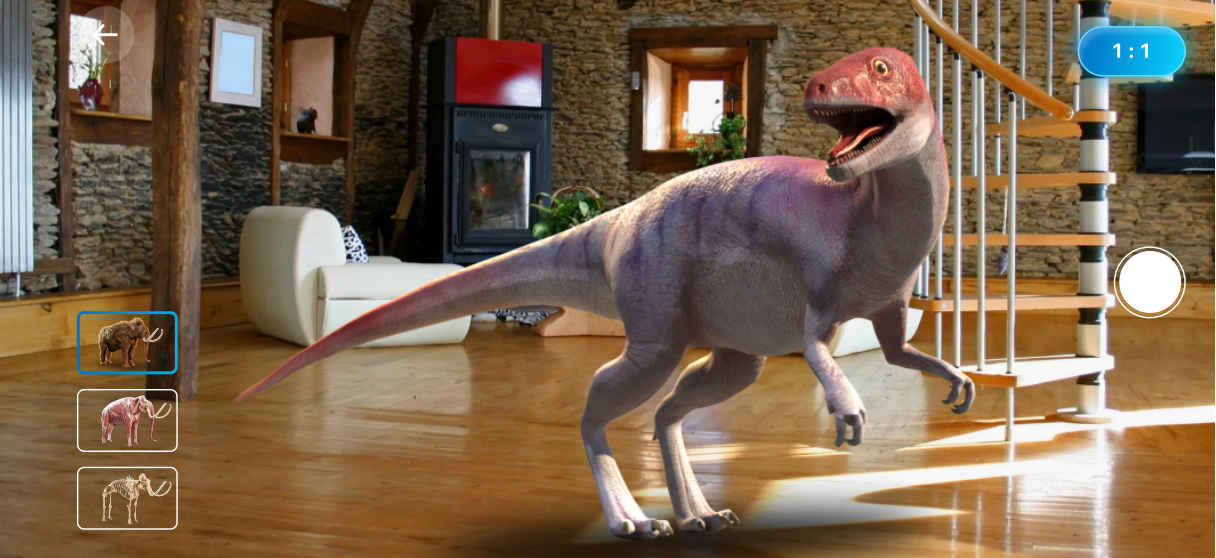
 AR - MODE
 GALLERY
 HISTORY OF DISCOVERIES

