


Sharovipteryx

Name meaning:
Sharov’s wing
Period of life:
242—227 million years ago
Period:
Triassic period
Habitat:
Lakes and marshes
Taxonomy:
Reptiles
Countries:



 Triadobatrachus


Chaohusaurus


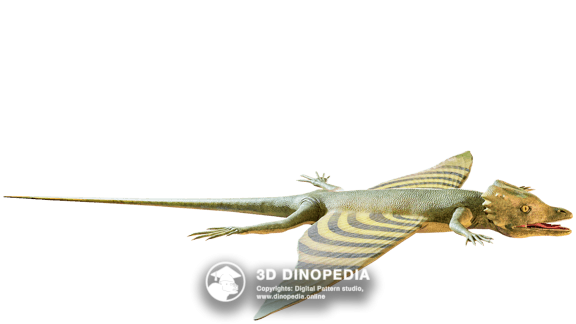
What does the name mean: Sharovipteryx mirabilis — “Sharov’s wing” (named in honor of paleontologist A. G. Sharov; from the Greek pteryx — “wing”).
Sharovipteryx mirabilis was a small reptile that lived during the Triassic period, from the Ladinian to Carnian ages, about 242–227 million years ago. The only known specimen was discovered in the Madygen Formation of present-day Kyrgyzstan. The fossil attracted scientific attention because of its unusual adaptations for gliding locomotion.
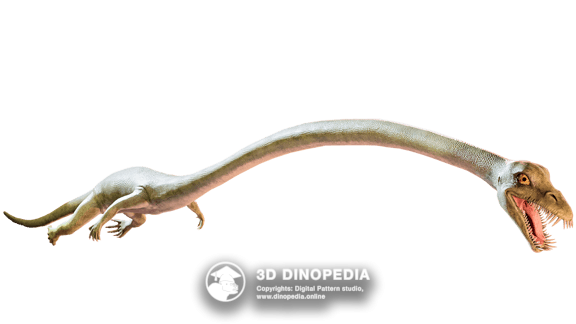
In appearance, Sharovipteryx mirabilis resembled a lizard with a long tail and strongly elongated hind limbs. The total body length including the tail was about 24 cm, and its mass was approximately 4–5 g. Its most distinctive feature was a skin membrane stretched between the hind limbs and tail, which may have been used for gliding.
The anatomy of Sharovipteryx mirabilis is only incompletely understood because it is known from a single specimen. Based on skeletal structure, the animal is thought to have been agile and capable of climbing. Its probable diet included insects and other small animals.
Sharovipteryx mirabilis inhabited an intermontane river system that existed in the Madygen region during the Triassic. This environment included lakes, oxbows, and temporary water bodies. The climate was seasonally arid, while the aquatic habitats were characterized by low productivity and reduced oxygen levels. Other reptiles were likely among its predators.
Sharovipteryx mirabilis is important for understanding the evolution of gliding vertebrates. Its anatomy differs from the known evolutionary lines leading to pterosaurs. Its possible relationships with other reptile groups remain controversial, as does the question of how well adapted it was for gliding.
Discussions
Start the first one!
 Start a discussion
Other animals







 INTERESTING FACTS
 PUZZLES
 HOME
HOME
 3D MODEL "SKIN"
 3D MODEL "MUSCLES"
 3D MODEL "SKELETON"
 VISION
 NEIGHBORS
 VOICE ACTING
 AR - MODE
 GALLERY
 HISTORY OF DISCOVERIES

