


Remingtonocetus

Name meaning:
Named in honor of Remington Kellogg
Period of life:
45–43.5 million years ago
Period:
Paleogene period
Habitat:
Marine environment
Taxonomy:
Mammals
Countries:




 Megalampris


Megalodon


What does the name mean: Remingtonocetus was named in honor of the American paleontologist Remington Kellogg.
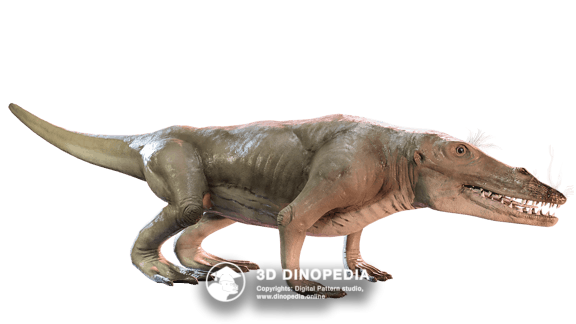
Remingtonocetus was an extinct genus of early cetaceans that inhabited the coastal waters of the ancient Tethys Ocean during the Middle Eocene, approximately 45–43.5 million years ago. Its fossil remains are known from India and Pakistan. This genus represents an important stage in cetacean evolution, reflecting the transition from terrestrial ancestors to fully aquatic forms.
Remingtonocetus was a relatively small cetacean about 2–3 m long. Its body was elongated and flexible, with a long tail. The structure of the pelvis and femur indicates that it retained functional hind limbs, which probably participated in locomotion in the water.
Unlike modern whales, whose hind limbs are strongly reduced, Remingtonocetus retained four well-developed limbs. The hind limbs were relatively long and were probably equipped with webbing. This allowed the animal to swim efficiently and, apparently, to retain the ability to move on land, indicating the transitional nature of its lifestyle.
The skull of Remingtonocetus was elongated, with a narrow snout and numerous teeth adapted for capturing slippery prey, primarily fish. The eyes were small and positioned on the sides of the head, providing a wide field of view.
Remingtonocetus was probably well adapted to life in coastal waters and estuaries — shallow environments with abundant food resources.
The study of Remingtonocetus is important for understanding the early stages of cetacean evolution and the transition from a terrestrial to an aquatic lifestyle.
Discussions
Start the first one!
 Start a discussion
Other animals








 INTERESTING FACTS
 PUZZLES
 HOME
HOME
 3D MODEL "SKIN"
 3D MODEL "MUSCLES"
 3D MODEL "SKELETON"
 VISION
 NEIGHBORS
 VOICE ACTING
 AR - MODE
 GALLERY
 HISTORY OF DISCOVERIES

