


Oviraptor

Name meaning:
Egg thief
Period of life:
75-71 mya
Period:
Cretaceous period
Habitat:
Deserts and semi-deserts
Taxonomy:
Theropods
Countries:




 Deinonychus


Anhanguera


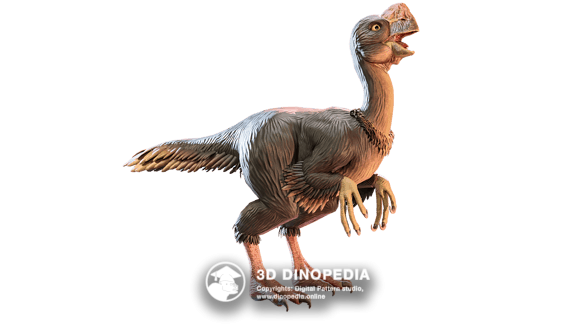
Oviraptor is one of the most famous members of the short-snouted theropods known as oviraptorids. These unusual dinosaurs lived during the Late Cretaceous, about 75 million years ago, in what is now Mongolia. It was there, in the harsh and majestic Gobi Desert, that their fossil remains were first discovered in 1923.
Oviraptor was relatively small but extremely agile. It ran easily on two legs, balancing with its tail, and had a distinctive appearance—its head resembled that of a parrot. It possessed a strong toothless beak, sharp claws on its forelimbs, and large eyes, suggesting good vision. Each forelimb had three long fingers armed with sharp claws—useful tools for obtaining food and for defense.
The name «Oviraptor» means «egg thief». When the first fossils were found, scientists mistakenly believed that this dinosaur was stealing the eggs of other animals. Later discoveries showed that it was most likely guarding its own nest.
Based on the structure of its beak and the ridged surfaces inside it, paleontologists have suggested that Oviraptor had a varied diet. Its strong beak was well suited for cracking hard food, such as shells and the exoskeletons of small invertebrates. However, bones of a small lizard were found in the stomach region of one specimen, indicating that animal prey was also part of its diet. Many researchers believe that Oviraptor was omnivorous and likely consumed plant material as well.
The fossils of Oviraptor were found in intensely red sedimentary rocks—deposits that typically form in arid environments. This suggests that it lived in relatively dry conditions, among sandy plains and sparse vegetation, where speed, caution, and adaptability were essential for survival.
Discussions
 Start a discussion
Other animals




 INTERESTING FACTS
 PUZZLES
 HOME
HOME
 3D MODEL "SKIN"
 3D MODEL "MUSCLES"
 3D MODEL "SKELETON"
 VISION
 NEIGHBORS
 VOICE ACTING
 AR - MODE
 GALLERY
 HISTORY OF DISCOVERIES

