


Mononykus
Name meaning:
Single claw
Period of life:
70 million years ago
Period:
Cretaceous period
Habitat:
Deserts and semi-deserts
Taxonomy:
Theropods
Countries:


 Bajadasaurus


Andrewsarchus


What does the name mean: The name Mononykus olecranus means “single claw” and comes from the Greek words monos — “single” and onyx — “claw.”
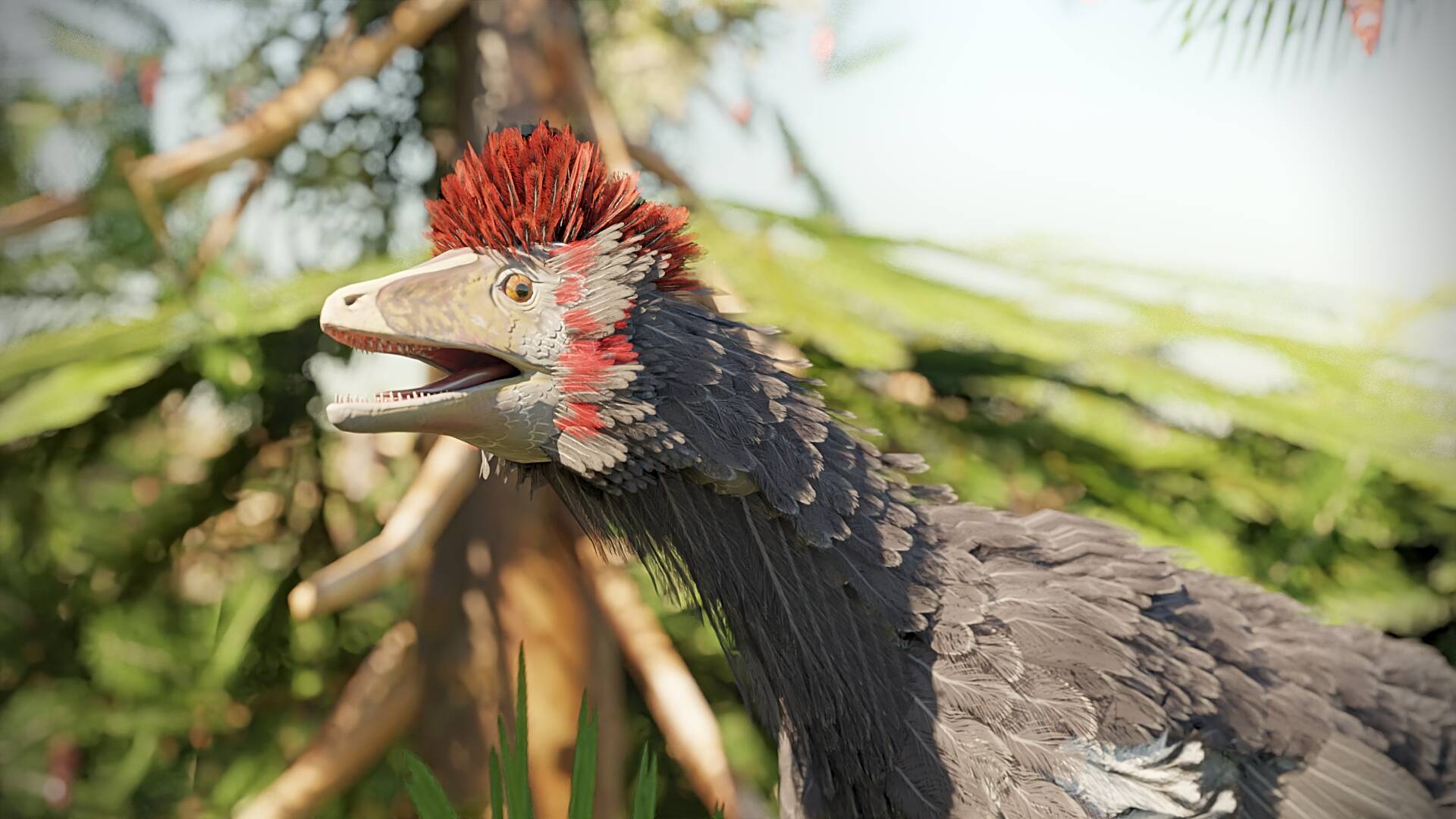
Mononykus olecranus was a small dinosaur that lived about 70 million years ago during the Late Cretaceous. Its remains were discovered in Mongolia, in the Gobi Desert — one of the key regions for the study of Mesozoic fauna. This dinosaur received its name because of the unusual structure of its forelimbs.
Mononykus olecranus was a small dinosaur comparable in size to a large bird: its body length exceeded 1 meter, and its mass was about 3 kg. It possessed an elongated skull with small sharp teeth adapted for feeding on insects and small animals. The body was lightweight, and the long hind limbs provided high mobility. However, the Late Cretaceous ecosystems of the Gobi were not deserts in the modern sense, but semi-arid plains with river valleys, floodplains, and temporary bodies of water.
The most distinctive feature of Mononykus olecranus was its forelimbs. They were strongly shortened and bore a single large claw up to 7.5 cm long. The exact function of this structure remains uncertain and continues to be debated.
It is thought that Mononykus olecranus fed mainly on insects and small animals. Its teeth were adapted for capturing such prey, while the powerful claw was probably used to break open nests of social insects such as termites or ants. This specialization is consistent with the presence of diverse insects, including colonial forms, in Late Cretaceous ecosystems.
Mononykus olecranus belonged to a group of theropods closely related to birds. It possessed features such as fused wrist bones and a keeled sternum. Its body was probably covered with feathers, as confirmed by discoveries in the closely related species Shuvuuia, in which feather impressions have been preserved. The study of Mononykus is important for understanding bird evolution and the diversity of theropods at the end of the Cretaceous period.
Discussions
Start the first one!
 Start a discussion
Other animals





 INTERESTING FACTS
 PUZZLES
 HOME
HOME
 3D MODEL "SKIN"
 3D MODEL "MUSCLES"
 3D MODEL "SKELETON"
 VISION
 NEIGHBORS
 VOICE ACTING
 AR - MODE
 GALLERY
 HISTORY OF DISCOVERIES

