


Homo erectus

Name meaning:
Upright man
Period of life:
1.9 million - 108 thousand years ago
Period:
Quaternary period
Habitat:
Savannas and plains
Taxonomy:
Mammals
Countries:





 Megalania


Hydrodamalis gigas



What does the name mean: The name “upright man” corresponds to the Latin Homo erectus, where Homo means “human” and erectus means “upright” or “standing erect”.
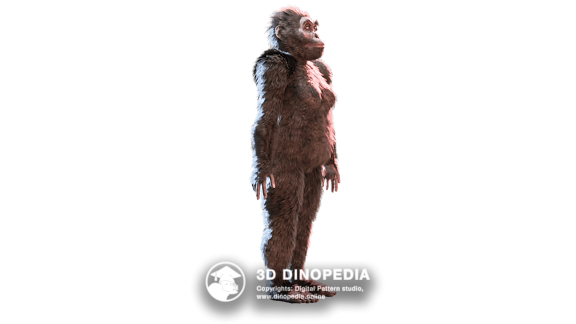
Homo erectus was an extinct species of ancient human that existed from about 1.9 million to approximately 108 thousand years ago. It moved confidently on two legs (possessed fully developed bipedal locomotion), which became an important stage in human evolution.
Originating in Africa, Homo erectus eventually spread across much of Eurasia — from present-day Spain to China. Such a wide distribution indicates a high degree of adaptability to different climates and landscapes.
In appearance, Homo erectus differed from modern humans but already possessed several advanced traits. Its height ranged from 1.5 to 1.8 meters, comparable to modern people. Bipedalism is confirmed by the structure of the femur, which resembles that of humans. The skull was more massive, with thick cranial bones, a sloping forehead, and pronounced brow ridges. The lower jaw lacked a chin. Brain volume ranged from about 850–1200 cm³ — larger than that of earlier hominins but smaller than that of modern humans.
Homo erectus produced stone and probably wooden tools, including hand axes, scrapers, and points. These implements, associated with the Acheulean culture, reflect the development of cognitive abilities. This species could obtain and maintain fire, which significantly expanded its capabilities: fire provided warmth, protection from predators, and allowed food to be cooked, increasing digestibility. The use of fire probably contributed to the occupation of colder regions.
Homo erectus was omnivorous. Its diet included fruits, seeds, and roots, as well as meat, which played an important nutritional role. Stone tools were used for obtaining and processing food; later populations probably engaged in active hunting. This species lived in groups, which provided advantages in hunting, protection from predators, and raising offspring. Such social organization required developed forms of communication.
Homo erectus played a key role in human evolution, becoming one of the first human species to spread widely beyond Africa and occupy diverse environments. Its existence laid the foundations for the emergence of Homo sapiens. The study of this species helps reconstruct the stages of human evolution and the factors that shaped it.
Discussions
Start the first one!
 Start a discussion
Other animals










 INTERESTING FACTS
 PUZZLES
 HOME
HOME
 3D MODEL "SKIN"
 3D MODEL "MUSCLES"
 3D MODEL "SKELETON"
 VISION
 NEIGHBORS
 VOICE ACTING
 AR - MODE
 GALLERY
 HISTORY OF DISCOVERIES

