


Cymbospondylus

Name meaning:
With cup-shaped vertebrae
Period of life:
251—242 million years ago
Period:
Triassic period
Habitat:
Marine environment
Taxonomy:
Marine reptiles
Countries:





 Triadobatrachus


Chaohusaurus
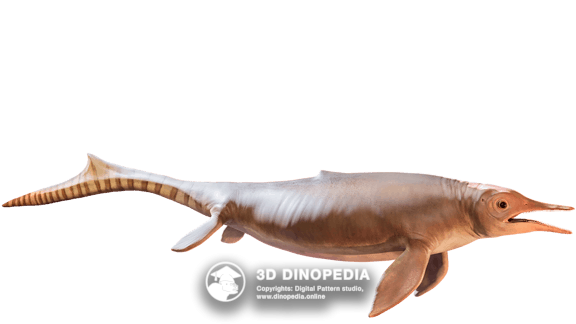


What does the name mean: Cymbospondylus youngorum (from Ancient Greek kymbē — “cup” and spondylos — “vertebra”) — “with cup-shaped vertebrae.”
Cymbospondylus youngorum was a large marine reptile that lived during the late Early to Middle Triassic, about 251–242 million years ago. Its fossils have been discovered in North America and Europe (Nevada, Germany, Italy, and Spitsbergen), indicating a wide distribution in ancient oceans.
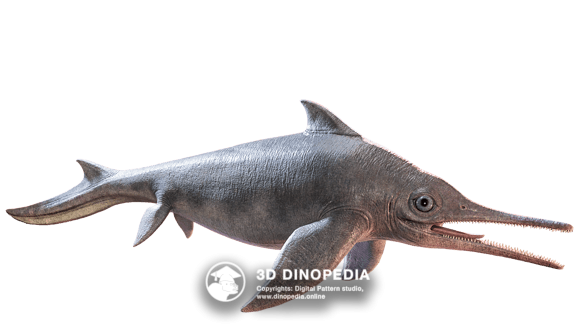
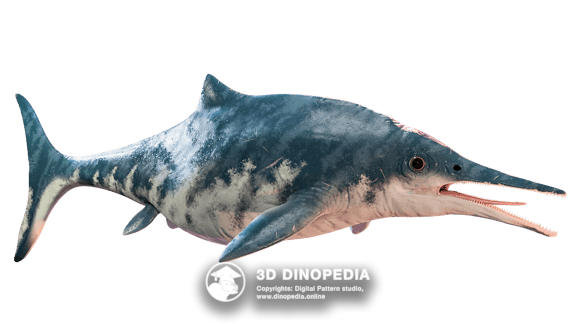
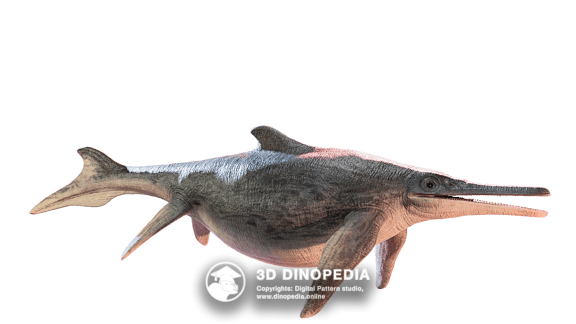
Cymbospondylus youngorum had an elongated body resembling that of marine crocodiles. Adult individuals could reach lengths of up to 17 m, with a significant portion of this length formed by the long tail, which provided propulsion in water.
The limbs of Cymbospondylus youngorum were transformed into flippers that likely served mainly a stabilizing function. Locomotion was primarily achieved through wave-like undulations of the body and tail.
The head was relatively small and ended in an elongated snout. The jaws contained numerous sharp teeth adapted for capturing prey, including smaller marine reptiles.
The anatomy of Cymbospondylus youngorum remains incompletely known because of the limited number of well-preserved skeletons. Its structure is thought to have resembled that of other early ichthyosaurs and likely included powerful musculature for efficient swimming.
A characteristic feature of Cymbospondylus youngorum is the shape of its vertebrae. Unlike later ichthyosaurs with disc-shaped vertebrae, its vertebrae were concave and cup-shaped. This feature is reflected in the genus name and is considered a sign of a more primitive anatomy.
Cymbospondylus youngorum was a large predator that likely fed on a variety of marine vertebrates.
Cymbospondylus youngorum is an important taxon for studying the early evolution of ichthyosaurs. Its anatomy helps illuminate the initial stages of adaptation of this reptile group to life in marine environments.
Discussions
Start the first one!
 Start a discussion
Other animals





 INTERESTING FACTS
 PUZZLES
 HOME
HOME
 3D MODEL "SKIN"
 3D MODEL "MUSCLES"
 3D MODEL "SKELETON"
 VISION
 NEIGHBORS
 VOICE ACTING
 AR - MODE
 GALLERY
 HISTORY OF DISCOVERIES

