


Ardipithecus

Name meaning:
Ground ape
Period of life:
5.7–4.4 million years ago
Period:
Neogene period
Habitat:
Woodlands
Taxonomy:
Mammals
Countries:




 Gomphotherium


Odobenocetops


What does the name mean: The name is derived from the Afar words “ardi” — “ground” or “floor,” “ramid” — “root,” and the Greek “pithecus” — “ape.” Together, it can be interpreted as “ground ape at the root of the evolutionary lineage.”
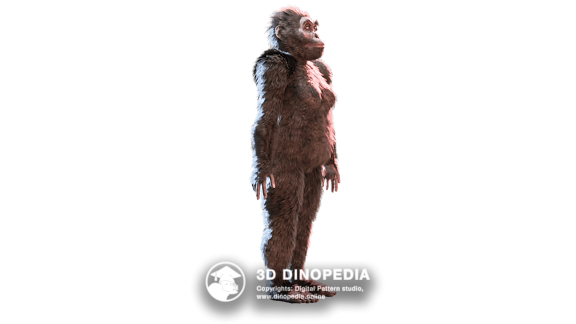
Ardipithecus was an early representative of the hominins that inhabited the territory of modern Ethiopia and Kenya during the Late Miocene and Early Pliocene, approximately 5.6–4.4 million years ago. During this Period, modern types of landscapes were forming, and the ancestors of humans were already beginning to develop signs of bipedalism.
The external appearance of Ardipithecus combined features characteristic of both great apes and early hominins. Its height was approximately 120 cm, and its mass about 32 kg. Brain volume ranged between 300–350 cm³, comparable to that of modern chimpanzees. Skeletal features indicate a combination of adaptations for climbing trees and moving on two legs.
The big toe (hallux) of Ardipithecus was divergent, as in modern apes, allowing effective grasping of branches. At the same time, the structure of the pelvis and lower limbs indicates adaptation to bipedalism. This suggests an ability to move both in trees and on the ground.
The teeth of Ardipithecus were relatively small and weakly specialized, indicating an omnivorous diet. Fruits, leaves, and young shoots probably formed the basis of the diet, although it may also have consumed insects, small animals, and eggs.
Data regarding the habitat of Ardipithecus are limited. Fossil remains of plants and animals discovered together with its bones indicate habitation in mosaic landscapes where forested areas alternated with open spaces. Such conditions may have contributed to the development of bipedalism in early hominins.
Ardipithecus occupies an important place in paleoanthropology. The study of its remains makes it possible to reconstruct the early stages of human evolution, including the emergence of bipedalism and the associated anatomical changes. These data help clarify the influence of environmental factors on the development of early hominins.
Discussions
Start the first one!
 Start a discussion
Other animals










 INTERESTING FACTS
 PUZZLES
 HOME
HOME
 3D MODEL "SKIN"
 3D MODEL "MUSCLES"
 3D MODEL "SKELETON"
 VISION
 NEIGHBORS
 VOICE ACTING
 AR - MODE
 GALLERY
 HISTORY OF DISCOVERIES

