


Hybodus

Name meaning:
Crooked tooth
Period of life:
247–66 mya
Period:
Cretaceous period
Habitat:
Marine environment
Taxonomy:
Sharks and rays
Countries:






 Darwinopterus


Iguanodon


What does the name mean: The name Hybodus comes from two Ancient Greek words: hýbos — “curved” and odoús — “tooth.” Thus, the literal translation of the name is “curved tooth,” directly referring to the distinctive shape of the teeth of these ancient sharks.
Hybodus was an extinct genus of cartilaginous fish belonging to the group of hybodont sharks (Hybodontiformes). These sharks inhabited Earth’s seas for an enormous span of time — from the Middle Triassic period (about 240 million years ago) to the Late Cretaceous (around 66 million years ago). In other words, hybodonts survived for more than 170 million years, enduring several mass extinction events.
Fossil remains of Hybodus have been found almost worldwide: in Europe, Asia, Africa, Australia, North America, and South America, indicating their wide distribution and ecological success. The genus Hybodus was first scientifically described in 1837 in England based on fossil teeth.
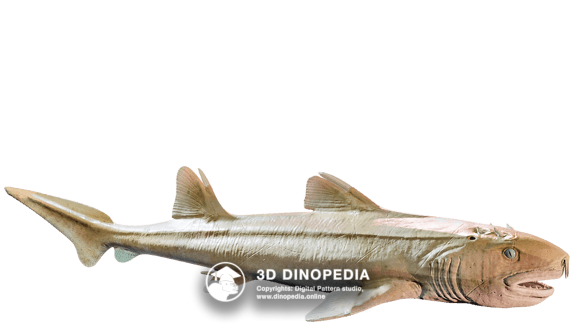
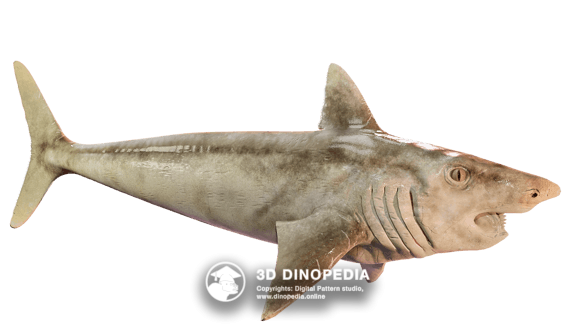
Hybodus was a relatively small shark. Most individuals reached 1.5–2 meters in length, although some specimens may have grown up to 3 meters. In body shape, it resembled modern sharks: its elongated, streamlined, torpedo-shaped body allowed efficient and fast swimming.
The back bore two dorsal fins of approximately equal size. At the base of the front dorsal fin was a large bony spine covered with longitudinal ridges and rows of tiny hook-like denticles. Most likely, this spine served as a defensive weapon against larger predators.
The tail fin was well developed and allowed Hybodus to make rapid bursts of speed, important both for hunting and escaping enemies.
One of the most remarkable features of Hybodus was the diversity of its teeth — a phenomenon known as heterodonty. At the front of the jaws were sharp, curved teeth ideal for grasping slippery prey such as fish or squid. In the rear part of the jaws were flatter, broader teeth designed for crushing hard shells — mollusks, crustaceans, and sea urchins.
Thanks to this “universal toolkit,” hybodonts could feed on a wide variety of prey and thrive in different marine ecosystems.
Like all sharks, Hybodus possessed a cartilaginous skeleton. However, this cartilage was calcified — enriched with calcium salts — making it stronger and more rigid than ordinary cartilage. This adaptation increased body stability and was important for an active lifestyle.
The internal anatomy of Hybodus generally resembled that of modern sharks:
• powerful musculature provided speed and maneuverability;
• gill slits enabled efficient underwater breathing;
• a two-chambered heart pumped blood through the body;
• a large fat-rich liver played a key role in maintaining buoyancy.
The intestine of Hybodus was relatively short, as is typical for predators, but at its end was a spiral valve — a specialized structure that increased the surface area for nutrient absorption and improved digestive efficiency.
The study of hybodont fossils plays an important role in understanding the evolution of cartilaginous fish and ancient marine ecosystems. Although cartilage is poorly preserved in the fossil record, numerous finds of teeth, fin spines, and skeletal fragments — together with comparisons to modern sharks — allow scientists to reconstruct the appearance and lifestyle of these animals with considerable accuracy.
However, the classification of Hybodus presents a serious scientific problem. Over more than a century and a half of research, too many different species were assigned to the genus, often based solely on isolated teeth. Today, Hybodus is considered what paleontologists call a “wastebasket taxon.” This means the genus likely contains species that are not actually close relatives.
Most likely, hybodonts in their traditional definition represent a polyphyletic group, and in the future the genus Hybodus will undergo major revision, with many species reassigned to separate, more accurate taxa.
Discussions
Start the first one!
 Start a discussion
Other animals




 INTERESTING FACTS
 PUZZLES
 HOME
HOME
 3D MODEL "SKIN"
 3D MODEL "MUSCLES"
 3D MODEL "SKELETON"
 VISION
 NEIGHBORS
 VOICE ACTING
 AR - MODE
 GALLERY
 HISTORY OF DISCOVERIES

