


Suminia

Name meaning:
Named in honor of Dmitry Sumin and Sergey Getmanov
Period of life:
268-252 million years ago
Period:
Permian period
Habitat:
Floodplains
Taxonomy:
Synapsids
Countries:



 Cotylorhynchus


Coelophysis


What does the name mean: Suminia getmanovi was named in honor of Dmitry Leonidovich Sumin and Sergey Nikolaevich Getmanov, who participated in the discovery of this animal.
Suminia getmanovi was a small animal that lived in what is now Russia during the Late Permian, around 268–252 million years ago. This synapsid belonged to the anomodonts — relatives of mammals. Its body length did not exceed 0.5 m. Suminia is considered one of the earliest vertebrates to adopt an arboreal lifestyle long before the appearance of dinosaurs.
Suminia getmanovi possessed anatomical adaptations associated with life in trees. Its spine was highly flexible, while the elongated neck provided a wide range of head movement. The limbs were long and slender, and the hands and feet were broad, with elongated grasping fingers. A partially opposable thumb has been noted, which would have improved branch grasping ability. The long tail probably served as a balancing organ.
The skull of Suminia getmanovi was short and tall, with large eye sockets that may indicate well-developed vision. Features of the dentition suggest a herbivorous diet. The front teeth were used for cutting vegetation, while the rear teeth were adapted for grinding it. This dental structure allowed efficient processing of tough plant material.
The internal anatomy of Suminia getmanovi remains poorly understood because of the limited fossil material available. However, the structure of the teeth and jaws indicates powerful chewing muscles and a digestive system adapted for processing plant food.
The discovery of Suminia getmanovi significantly changed scientific views on the early evolution of terrestrial ecosystems. Previously, it was believed that arboreal lifestyles evolved much later, but Suminia demonstrates a much earlier origin of this adaptation. Other early forms that may also have lived in trees are now known, including Eoscansor, which lived during the Carboniferous period.
The study of Suminia getmanovi contributes to understanding evolutionary processes associated with the occupation of new ecological niches. This genus demonstrates early stages in the development of arboreal lifestyles among vertebrates and their influence on the evolution of terrestrial ecosystems.
Discussions
Start the first one!
 Start a discussion
Other animals




 INTERESTING FACTS
 PUZZLES
 HOME
HOME
 3D MODEL "SKIN"
 3D MODEL "MUSCLES"
 3D MODEL "SKELETON"
 VISION
 NEIGHBORS
 VOICE ACTING
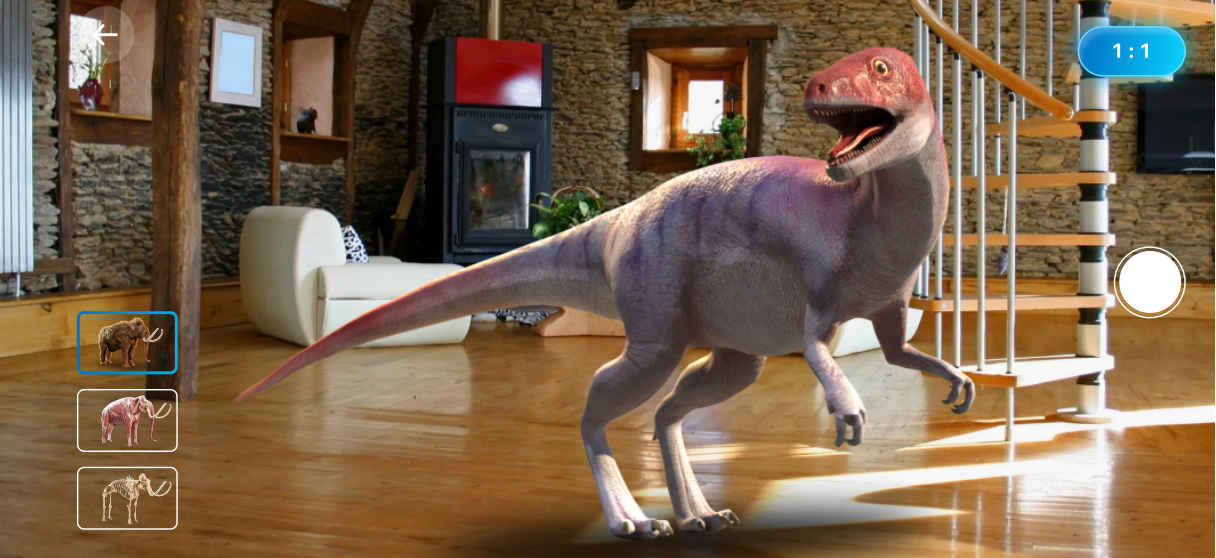
 AR - MODE
 GALLERY
 HISTORY OF DISCOVERIES

