


Platybelodon

Name meaning:
Flat-tusked one
Period of life:
15-10 mya
Period:
Neogene period
Habitat:
Lakes and marshes
Taxonomy:
Mammals
Countries:






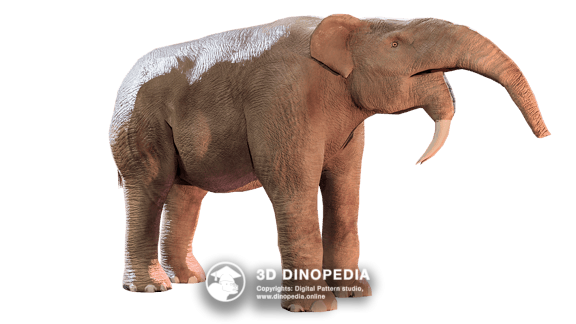 Deinotherium


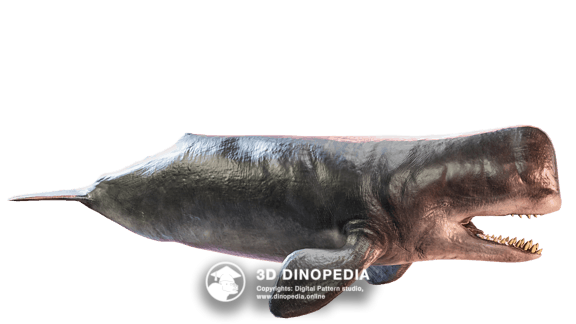
Leviathan


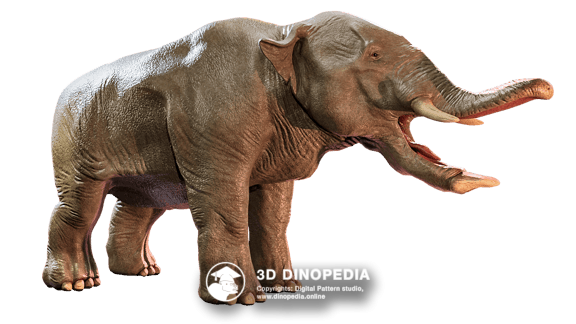
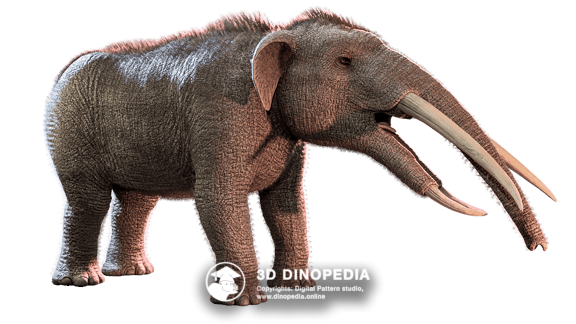
Platybelodon is a remarkable extinct proboscidean that lived during the Miocene epoch, about 18–9 million years ago, across Eurasia. The animal became known to science thanks to Russian paleontologists, who discovered its first fossils in 1927 in the North Caucasus.
Platybelodon was a large animal for its time: its body length reached about 6 meters, its height nearly 3 meters, and its mass could exceed 4 tons. It was related to modern elephants but looked far more unusual, with an elongated lower jaw ending in flattened, fused incisors resembling a broad shovel.
For a long time, scientists believed that this «shovel-jawed» proboscidean used its jaws to gather aquatic vegetation, covering plants with its upper lip and digging them out of the mud. However, recent studies of microscopic wear patterns on the teeth suggest a different picture. Based on the nature of the scratches, Platybelodon likely cut bark and branches, using its lower incisors as a kind of built-in cutting tool.
In appearance, Platybelodon combined features of an elephant and a hippopotamus. From elephants it inherited four tusks (two upper and two lower), a massive body, and possibly a short trunk. From hippopotamuses it shared comparable bulk and, presumably, a semi-aquatic lifestyle: it may have spent much of its time near water, where it found food and relief from heat.
This unique morphology makes Platybelodon one of the most unusual representatives of the proboscideans—a reminder of how diversely nature experimented with body plans long before the emergence of humans.
Discussions
Start the first one!
 Start a discussion
Other animals







 INTERESTING FACTS
 PUZZLES
 HOME
HOME
 3D MODEL "SKIN"
 3D MODEL "MUSCLES"
 3D MODEL "SKELETON"
 VISION
 NEIGHBORS
 VOICE ACTING
 AR - MODE
 GALLERY
 HISTORY OF DISCOVERIES

