


Leedsichthys

Name meaning:
Leeds’ fish
Period of life:
165–148 million years ago
Period:
Jurassic period
Habitat:
Marine environment
Taxonomy:
Bony fish
Countries:





 Hybodus


Iguanodon


What does the name mean: the name means “Leeds’ fish” and was given in honour of the British collector Alfred Nicholson Leeds.
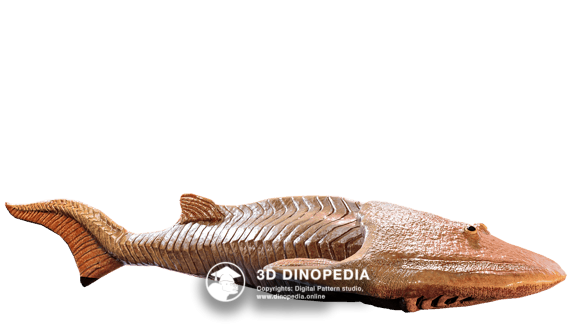
Leedsichthys problematicus was an extinct genus of pachycormid fishes (Pachycormidae) that inhabited the seas of the Middle and Late Jurassic, about 165–148 million years ago. It was one of the largest known ray-finned fishes in Earth’s history. Remains of this giant, reaching lengths of up to 16 metres, have been discovered in England, Argentina, France, Germany, and Chile. Fossils collected by Alfred Nicholson Leeds played a particularly important role, and in 1889 the genus was named in his honour.
The fossils of Leedsichthys problematicus are difficult to interpret because parts of its skeleton consisted of cartilage, which preserves poorly in the fossil record. As a result, some discoveries were initially mistaken for bones of other animals, including stegosaurs. The absence of well-preserved vertebrae complicates accurate body length estimates, and for a long time the proposed size varied considerably. Modern studies suggest that the maximum length may have reached approximately 16–17 metres.
Recovered skull elements indicate a large head with characteristic projections. Fin rays suggest the presence of large pectoral fins and a powerful tail fin. The gill arches were equipped with a complex filtering apparatus that allowed the animal to extract plankton from the water. Leedsichthys problematicus probably fed by passing enormous volumes of water through its gill system.
Together with related genera such as Bonnerichthys and Rhinconichthys, Leedsichthys problematicus belonged to a group of giant plankton-filtering fishes that existed in Mesozoic seas. Pachycormid fishes are regarded as an early branch of bony fishes (Osteichthyes), making Leedsichthys one of the largest representatives of this group.
Despite its enormous size, Leedsichthys problematicus may itself have been preyed upon by large marine predators. One likely predator was the pliosaurid Liopleurodon, which possessed powerful jaws capable of attacking very large animals.
Because of the unusual preservation of its skeleton, information about Leedsichthys remains limited. Nevertheless, its study provides important insights into the structure of Jurassic marine ecosystems.
Discussions
Start the first one!
 Start a discussion
Other animals






 INTERESTING FACTS
 PUZZLES
 HOME
HOME
 3D MODEL "SKIN"
 3D MODEL "MUSCLES"
 3D MODEL "SKELETON"
 VISION
 NEIGHBORS
 VOICE ACTING
 AR - MODE
 GALLERY
 HISTORY OF DISCOVERIES

