


Hoplophoneus

Name meaning:
Armed killer
Period of life:
35–29 million years ago
Period:
Paleogene period
Habitat:
Woodlands
Taxonomy:
Mammals
Countries:





 Megalampris


Megalodon


What does the name mean: Hoplophoneus derives from the Ancient Greek words ὅπλον (“weapon”) and φονεύς (“killer”) and translates as “armed killer”.
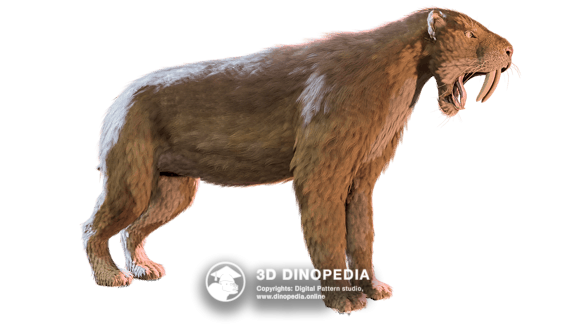
Hoplophoneus was an extinct genus of predatory mammals that lived in North America during the Late Eocene and Early Oligocene (35–29 million years ago). Despite its external resemblance to modern felids, it was not their direct ancestor. Hoplophoneus belongs to the family Nimravidae, known as the “false sabertoothed cats.” These animals evolved in parallel with true felids and independently acquired similar morphological features.
Hoplophoneus was a medium-sized predator comparable to a modern leopard. Its body length ranged from approximately 1 to 1.5 m, and its mass from 25 to 65 kg. A characteristic feature, as in other nimravids, was the presence of elongated saber-shaped canines protruding beyond the lower jaw even when the mouth was closed. To protect these teeth, the lower jaw possessed bony projections — flanges — serving a protective function.
The limbs of Hoplophoneus were relatively short and robust, indicating adaptation for rapid bursts of speed over short distances rather than prolonged pursuit. It is assumed that it employed an ambush-hunting strategy. Body proportions and limb structure also allowed effective movement through dense vegetation and probably enabled climbing ability.
The diet of Hoplophoneus probably included small and medium-sized herbivorous mammals such as Mesohippus, as well as other representatives of the North American fauna of that time. The study of fossil remains of Hoplophoneus helps reconstruct ancient ecosystems and refine understanding of carnivorous mammal evolution.
Discussions
Start the first one!
 Start a discussion
Other animals







 INTERESTING FACTS
 PUZZLES
 HOME
HOME
 3D MODEL "SKIN"
 3D MODEL "MUSCLES"
 3D MODEL "SKELETON"
 VISION
 NEIGHBORS
 VOICE ACTING
 AR - MODE
 GALLERY
 HISTORY OF DISCOVERIES

