


Peteinosaurus

Name meaning:
Winged lizard
Period of life:
218–215 million years ago
Period:
Triassic period
Habitat:
Marine environment
Taxonomy:
Pterosaurs
Countries:



 Chaohusaurus


Diplodocus


What does the name mean: The name comes from the Greek words peteinos (“winged”) and sauros (“lizard”).
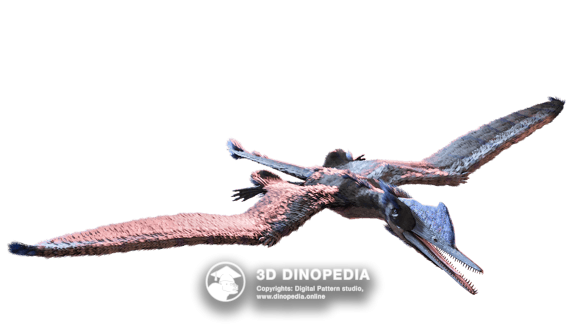
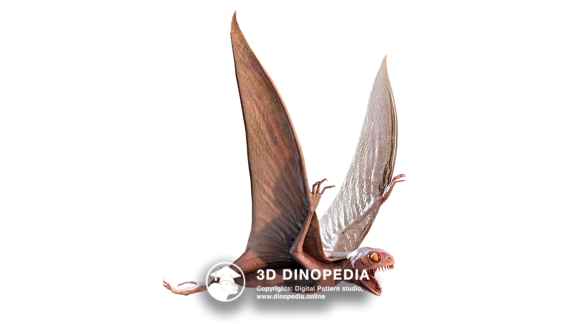
Peteinosaurus was one of the early and relatively small pterosaurs that lived during the Late Triassic period about 218–215 million years ago. Its fossils have been discovered in Italy. This animal was small in size: its wingspan was about 60 cm, although some estimates suggest it may have reached 1 metre.
Peteinosaurus possessed a lightweight but strong skeleton characteristic of pterosaurs. Its teeth were conical and varied in shape, indicating an insectivorous diet. The fifth toe of the hind limb was elongated and lacked a claw; it could bend in a different plane and probably helped support the cruropatagium — the skin membrane stretched between the hind limbs.
Despite its small size, Peteinosaurus displayed several distinctive features. Its wings were relatively short compared with those of later pterosaurs: their length was approximately twice that of the hind limbs. In addition, it possessed a long stiff tail that may have functioned as a stabiliser during flight. A vertical vane may also have been present at the tip of the tail, as seen in many early long-tailed pterosaurs.
Based on available evidence and comparisons with other pterosaurs, several aspects of the anatomy of Peteinosaurus can be inferred. It had a lightweight skeleton with hollow bones, reducing body mass and facilitating flight. The wings consisted of a skin membrane stretched between the elongated fourth finger of the forelimb and the body. It probably possessed well-developed flight musculature necessary for active flight.
Its respiratory system is thought to have been more efficient than that of most reptiles, although precise information about the structure of the heart and lungs is unavailable.
Peteinosaurus probably inhabited coastal environments and fed on insects. Its small conical teeth allowed it to grasp prey effectively. It may have captured insects in flight or picked them from surfaces. As one of the earliest known pterosaurs, Peteinosaurus provides important information about the initial stages of pterosaur evolution and adaptation to flight.
Discussions
Start the first one!
 Start a discussion
Other animals





 INTERESTING FACTS
 PUZZLES
 HOME
HOME
 3D MODEL "SKIN"
 3D MODEL "MUSCLES"
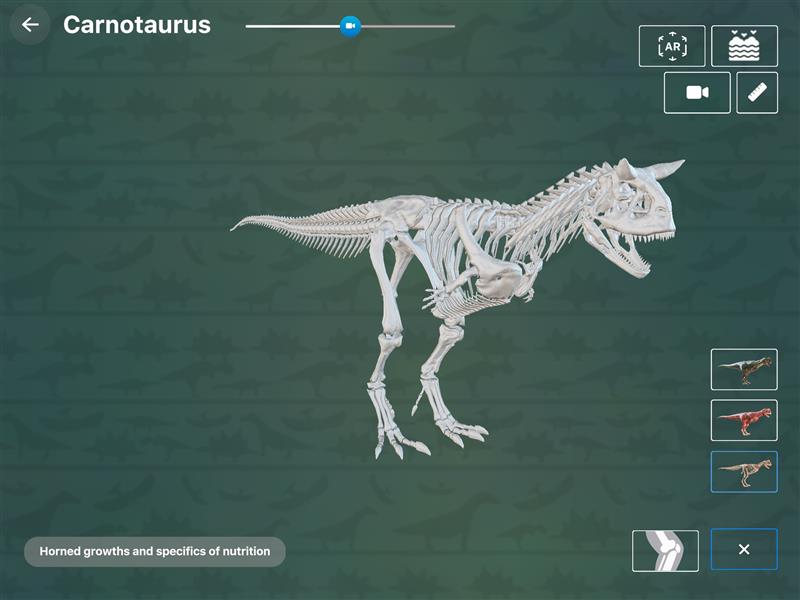
 3D MODEL "SKELETON"
 VISION
 NEIGHBORS
 VOICE ACTING
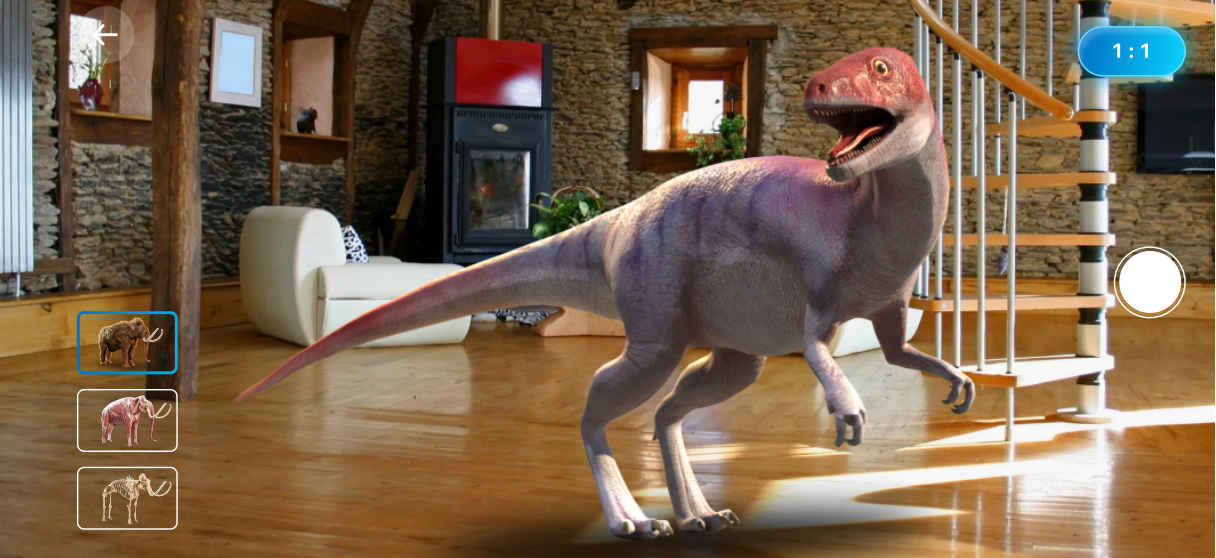
 AR - MODE
 GALLERY
 HISTORY OF DISCOVERIES

