


Metriorhynchus

Name meaning:
Moderately long snout
Period of life:
155–149 million years ago
Period:
Jurassic period
Habitat:
Marine environment
Taxonomy:
Crocodilians
Countries:





 Hybodus


Iguanodon


What does the name mean: “moderately long snout” — from the Greek words metrios (“moderate”) and rhynchos (“snout, muzzle”).
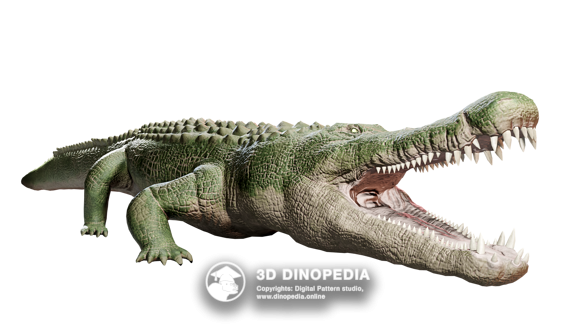
Metriorhynchus was a marine crocodylomorph that lived during the Late Jurassic Period, approximately 155–149 million years ago. Unlike modern crocodiles, it was fully adapted to life in the sea. Its fossils have been discovered in Europe (England, France, Germany) and South America (Chile, Argentina), indicating a wide geographic distribution.
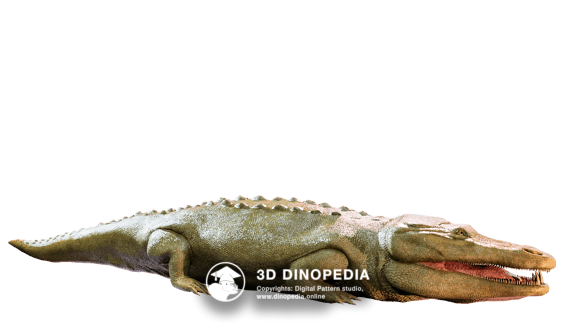
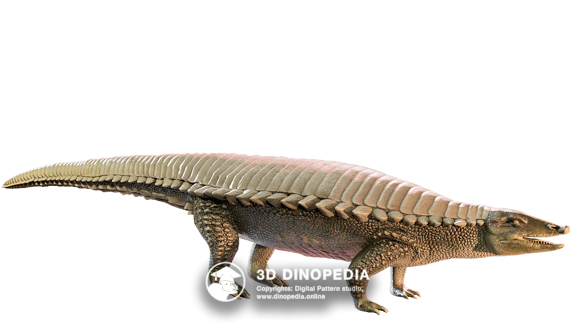
The body of Metriorhynchus was streamlined and reached about 3 m in length. The skin was smooth and lacked the osteoderms characteristic of terrestrial crocodylomorphs. The limbs transformed into flippers that provided maneuverability in water. The tail, equipped with a vertical fin, served as the primary propulsive structure. The jaws were elongated and equipped with sharp teeth adapted for seizing slippery prey.
The internal anatomy of Metriorhynchus reflects adaptation to a marine environment. It possessed well-developed salt glands that allowed excess salt ingested with seawater to be expelled. This provided the ability to remain in the marine environment for extended periods without the need to return to land.
Metriorhynchus was a predator with a varied diet that included fish, cephalopods, and other marine animals. It likely could also feed on carrion. Some fossils contain remains of large fish, such as Leedsichthys, which reached lengths of about 17 m. However, such finds most likely reflect scavenging on already dead prey.
The study of Metriorhynchus provides important insight into the evolution of crocodylomorphs and their adaptation to marine environments. This genus demonstrates the transition from a terrestrial to a fully aquatic lifestyle.
Discussions
Start the first one!
 Start a discussion
Other animals






 INTERESTING FACTS
 PUZZLES
 HOME
HOME
 3D MODEL "SKIN"
 3D MODEL "MUSCLES"
 3D MODEL "SKELETON"
 VISION
 NEIGHBORS
 VOICE ACTING
 AR - MODE
 GALLERY
 HISTORY OF DISCOVERIES

