


Longisquama

Name meaning:
Long-scaled
Period of life:
239-235 million years ago
Period:
Triassic period
Habitat:
Lakes and marshes
Taxonomy:
Reptiles
Countries:



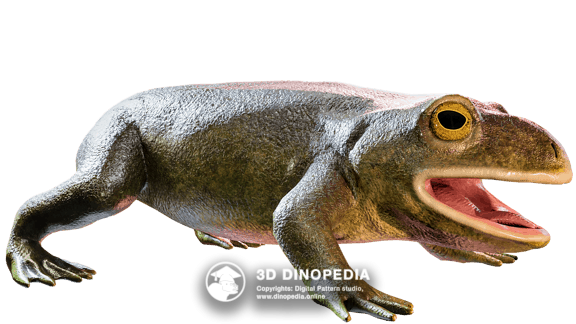 Triadobatrachus


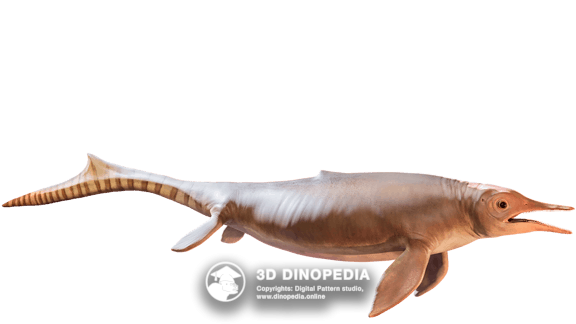
Chaohusaurus


What does the name mean: “long-scaled” (from the Latin longus — “long” and squama — “scale”).
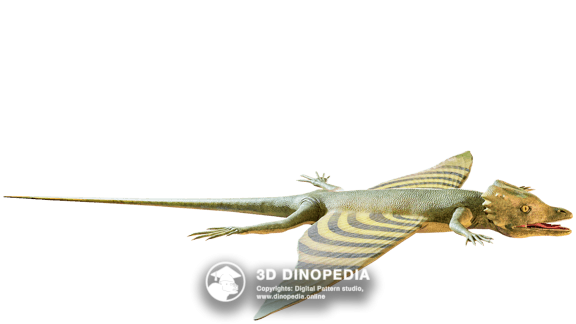
Longisquama insignis was a small reptile that lived in what is now Central Asia during the Triassic period, about 239–235 million years ago. This taxon attracts the attention of paleontologists because of its unusual dorsal appendages resembling feather-like structures, as well as its uncertain systematic position.
The fossils of Longisquama insignis, discovered in 1969 in the Madygen Formation of Kyrgyzstan, are represented by an incomplete skeleton. Nevertheless, the preserved fragments allow reconstruction of some aspects of its anatomy. Its body length likely did not exceed 10 cm.
The skull of Longisquama insignis was relatively high, with pronounced occipital projections. Large eye sockets indicate well-developed vision. The teeth were small and conical, consistent with an insectivorous diet. The structure of the limbs suggests an arboreal lifestyle. The forelimbs were elongated, with well-developed hands consisting of five fingers. The first, second, and fourth fingers were of similar length, while the fifth was shorter. Features of the shoulder girdle provided high mobility to the forelimbs.
The most distinctive feature of Longisquama insignis was its elongated dorsal appendages, up to 28 cm long, arranged along the back. Each appendage consisted of two elongated elements connected along the anterior edge, and partially along the posterior edge and central region. The distal portions of the appendages were slightly curved backward.
The limited preservation of the material makes detailed study of the anatomy of Longisquama insignis difficult. The posterior part of the body, including the hind limbs and tail, has not been preserved. The systematic position of this taxon remains controversial, and its relationships with other reptiles continue to be debated.
Discussions
Start the first one!
 Start a discussion
Other animals






 INTERESTING FACTS
 PUZZLES
 HOME
HOME
 3D MODEL "SKIN"
 3D MODEL "MUSCLES"
 3D MODEL "SKELETON"
 VISION
 NEIGHBORS
 VOICE ACTING
 AR - MODE
 GALLERY
 HISTORY OF DISCOVERIES

