


Dinilysia

Name meaning:
Named in honor of Alfredo Dini
Period of life:
85 million years ago
Period:
Cretaceous period
Habitat:
Deserts and semi-deserts
Taxonomy:
Lizards and snakes
Countries:



 Armadillosuchus


Bajadasaurus


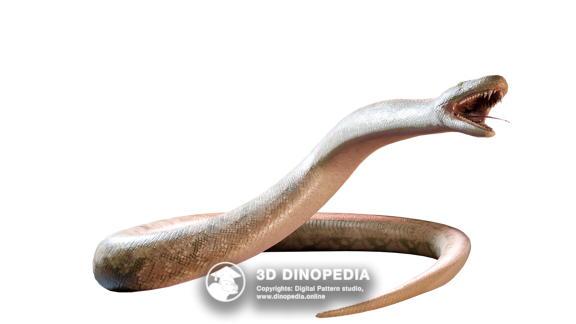
What does the name mean: the name Dinilysia comes from the Greek word deinos — “terrible” and the obsolete genus name Ilysia, formerly applied to the modern coral snake Anilius scytale.
Dinilysia patagonica was an extinct genus of snakes that lived during the Late Cretaceous, in the Coniacian Age (approximately 89 million years ago). Its fossil remains were discovered in Argentina, in Neuquén Province, within the Anacleto Formation.
Dinilysia patagonica was a predatory snake about 2 meters long. The structure of its skull shows similarities to modern boas (Boidae), which may indicate the ability to hunt relatively large prey.
It is assumed that Dinilysia patagonica led a terrestrial or semi-fossorial lifestyle. It may have been capable of detecting ground vibrations, which helped it locate prey and avoid predators.
The habitat of Dinilysia patagonica included various landscapes of Late Cretaceous South America. It is assumed that it may have inhabited relatively dry environments, although the exact environmental characteristics remain under study.
Dinilysia patagonica apparently was an ambush predator. Its diet probably included small vertebrates such as lizards and early mammals.
Dinilysia patagonica represents an important subject for the study of early snake evolution. Features of its anatomy, including the structure of the inner ear, provide information about the origin of fossorial and terrestrial lifestyles in this group.
Discussions
Start the first one!
 Start a discussion
Other animals






 INTERESTING FACTS
 PUZZLES
 HOME
HOME
 3D MODEL "SKIN"
 3D MODEL "MUSCLES"
 3D MODEL "SKELETON"
 VISION
 NEIGHBORS
 VOICE ACTING
 AR - MODE
 GALLERY
 HISTORY OF DISCOVERIES

